
Industrial Automation Integration
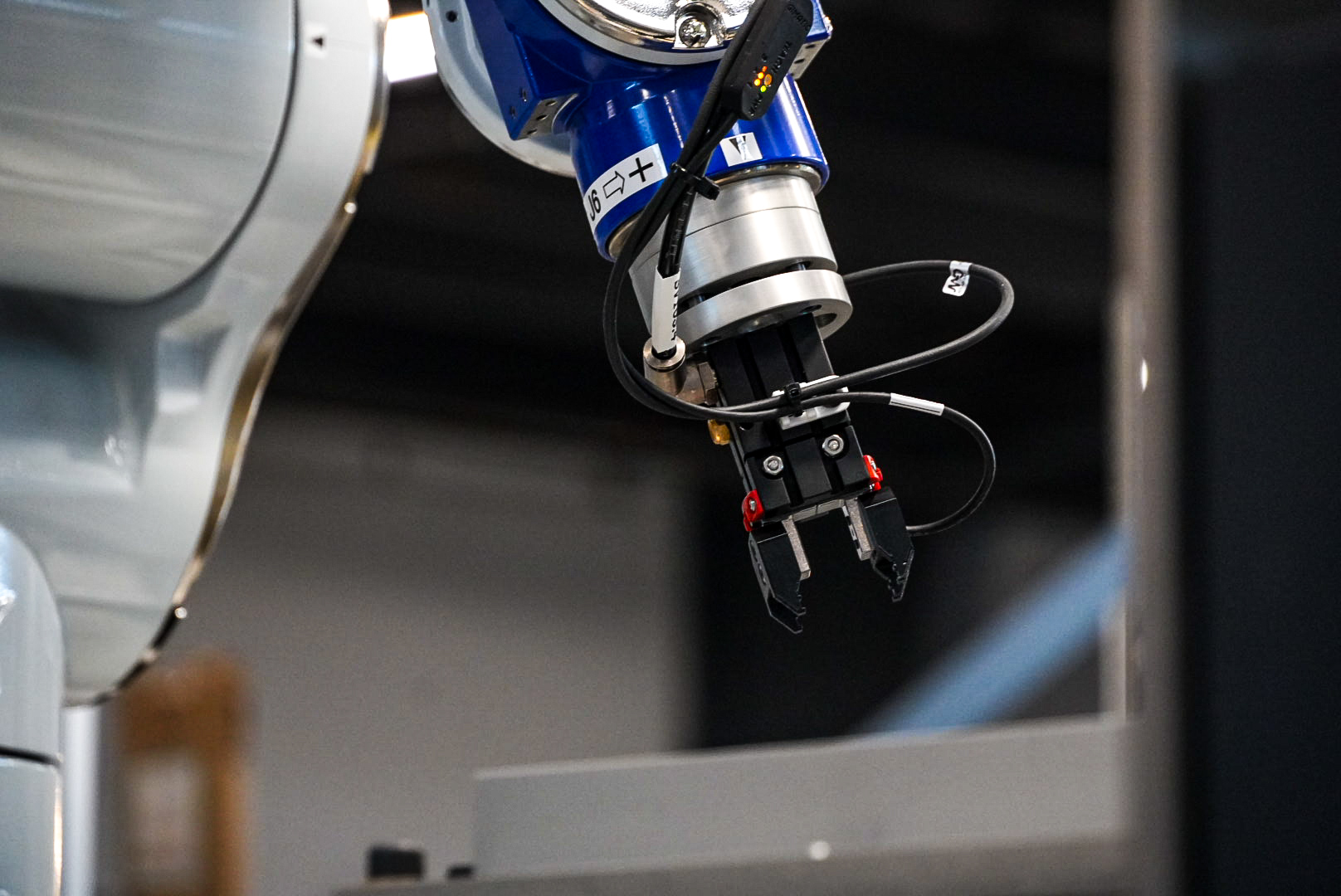
Labor is getting harder to find, output requirements keep climbing, and the machine in the middle hasn’t changed. This is the gap that industrial automation integration is supposed to close, and it’s the problem most manufacturers are trying to solve when they call us. The work is repetitive, the people to do it are increasingly scarce, and the line between throughput and quality is narrower than it should be.
Applied Motion Systems – based in Vancouver, Washington – is one of the Pacific Northwest’s most experienced industrial automation integrators. We’ve been engineering custom industrial automation solutions and specialty machines for manufacturers since 1995. Our work spans single-axis drive replacements, multi-robot workcells, and factory automation systems with hundreds of axes of control.
Most of the processes we work on aren’t broken; they’re constrained. They were designed for yesterday’s output requirements, and the team running them has exhausted every available workaround. Our job is to find the constraint, understand why it exists, and build something that removes it without creating new ones.
What We Do
Robotic Workcell Integration
We design and integrate robotic workcells around your production environment, including floor space, cycle time, upstream and downstream dependencies, operator touchpoints, and maintenance access. Cell design, fabrication, controls, and programming come together under one roof. We engineer the system and its logic together.
Custom Machine Design
Not every automation problem involves a robot. AMS designs and builds custom machines from the ground up for applications where no off-the-shelf solution exists. These projects have opened doors in industries where AMS hadn’t previously worked, and they follow the same engineering discipline as each of our engagements: understanding the process is our first priority, then we design to optimize it.
PLC, HMI & SCADA Programming
AMS programs PLCs, HMIs, and SCADA systems for motion control and industrial automation integration applications. We write code to be read by the maintenance team who takes ownership of it, not just by the engineer who wrote it. We design HMIs for the operator who runs the machine every shift. Machine logic is written with a thorough understanding of the machine, the production environment, the duty cycle requirements, and those who are responsible for keeping it running.
Automation Retrofit and Modernization
When aging drives, controllers, or motion systems reach end of life, we engineer the retrofit in a manner that enhances and optimizes the equipment that still has decades of value. We handle control system retrofits for manufacturing environments of all kinds, from single-drive replacements to full control system rebuilds. We start with the mechanical system, taking care to understanding the motor-to-load relationship, drivetrain, and inertia details. This work comes before anything gets specified in the cabinet. The result is a system that when pressed into production, consistently outperforms the original design.
Machine Safety and Guarding
Most guarding failures come from guarding that is not designed around how the machine is operated. AMS integrates fixed guarding, interlocked perimeter systems, light curtains, and presence-sensing devices into the broader control system architecture. Every machine safety upgrade and retrofit starts with a risk assessment. The result works with operator workflows to facilitate enhanced safety and ease of use. The outcome is a system that’s safer to operate, easier to maintain, and more productive as a result.
Control Panel Fabrication
When a system needs a new panel, whether for a repair, drive conversion, or retrofit, AMS designs and builds it in-house. As a UL 508A certified manufacturer, we engineer every panel as part of the control system it serves. Our engineering team in Vancouver, Washington handles layout, wiring, and testing.
The Problem We’re Optimized For
Discovery Before Specification
Before we recommend anything, we look at the process, talk to the people who run it, and ask why it’s doing what it’s doing, not just what it’s doing wrong. That means understanding the environmental conditions, required duty cycle, quality metrics, and the expertise of the in-house team who will maintain the system after we leave.
This discovery process is where the real work happens. A constraint that looks like a controls problem is often a mechanical problem. A machine that looks like it needs replacing often has decades of useful life left in it. We don’t commit to a scope until we’ve completed a proper discovery.
Mechanical Engineering Before Controls
In drive system work, if the motor selection, drivetrain, and inertia relationships aren’t right for the process you’re trying to run, you can’t fix it in software. AMS first conducts a thorough machine dynamic analysis: motor-to-load relationship, reflected inertia, drivetrain stiffness, and torque requirements. That foundation is what makes for a stable production machine and equipment that will last.
Engineered and Built for the Operator
We design for the operator as much as the engineer. If the person running the machine every shift can’t decipher what it’s telling them, the system isn’t finished. We build HMIs for operators who need to read machine status at a glance with clarity and understanding. Alarm structures and diagnostics point the maintenance team toward specific fault events and needed actions for resolution rather than simply annunciating a fault code. And, our engineers write control software that your team can troubleshoot without needing to call us.
These principles show up differently on every project. Here is what this looks like on one such project.
A Pacific Northwest manufacturer of insulated coffee sleeves came to AMS with two production lines that couldn’t meet volume and quality requirements even running multiple shifts per day. One ran scatter print at 600 sleeves per minute, and the other ran pre-printed stock with reliable image placement, but topped out at 60 sleeves per minute. What they needed was a single machine that could do both.
The assumption going in was that better controls were the answer. The real constraint turned out to be thermal: at elevated cycle rates, hot melt glue applied to the sleeve bond area didn’t have time to set before the sleeve was folded, crimped and released. No amount of control sophistication would change adhesive physics. Working backward from the glue’s thermal properties, AMS established 3,000 sleeves per minute as the theoretical ceiling. The solution was vortex coolers integrated downstream of the glue station, creating a controlled low-temperature zone that shortened the time required for the adhesive to set. This new machine concept replaced both lines and runs fast enough that the customer meet all of their customer demand running a single shift per day.
Built and Commissioned Under One Roof
AMS operates from a 50,000 sq ft engineering and manufacturing facility in Vancouver, Washington. Mechanical and electrical engineering, fabrication and CNC machine shops, and a UL 508A certified panel shop are all in-house. The facility includes crane capacity and floor space to set up and run a machine before it ships.
On a complex retrofit or custom machine build, having all of that under one roof matters. Control system design, panel fabrication, programming, and commissioning happen as an integrated process, not handed off between organizations. We engineer the mechanical, electrical, and software scope together. The system that arrives at your facility is proven and has already run your product.
Founded in 1995, AMS has grown from two veteran engineers to a team of over 50 engineers, machinists, and technicians. The range of work reflects that depth: from a 122-axis carbon fiber layup machine to an undersea tidal generator array, the common thread is solving problems that require an informed engineering solution, not a catalog selection.
Platform Expertise
If you know what platform you’re running, you want an industrial automation system integrator who knows it well, AMS has decades of experience across a broad range of technology platforms.
Rockwell Automation / Allen-Bradley
The majority of AMS projects run on Rockwell platforms. We work with PowerFlex 755 and Kinetix 5700 drive systems and ControlLogix / CompactLogix with integrated GuardLogix safety. AMS assisted Rockwell in the development and refinement of the PowerFlex 755 drive series with CIP motion.
Siemens
AMS is a Siemens Certified Solution Partner for Factory Automation, Motion Control, and CNC. We work with SIMATIC S7 PLCs, WinCC HMIs, SINAMICS drives, SIMOTION controllers, and SINUMERIK CNC systems. Siemens drives are strong in large-horsepower applications, and we have designed mixed-platform systems that use Siemens active line modules alongside Rockwell drives on a common bus.
Nidec / Control Techniques
AMS is a Nidec / Control Techniques Certified Integrator Partner. We have deployed over 3,000 Control Techniques drives in North America over 25 years, across the Unidrive SP, Unidrive M, and Digitax HD platforms for single- and multi-axis motion applications.
ABB
AMS has experience with ABB ACS 880 and DCS 880 drive systems and works with ABB through regional representative relationships on modernization projects and safety upgrades.
AMS also holds partner status with FANUC, Epson, Staubli, and Yaskawa for robotics integration, and deploys Cognex, Keyence, and Apera AI for vision and inspection applications. For SCADA and HMI, we work with AVEVA, Indusoft, and Ignition depending on the application.
The right platform depends on the application, the environment, and what your team will be maintaining years from now, which is why we make that recommendation based upon seeking the best outcome for the customer following a thorough review of engineering, production, maintenance, and economic considerations.
Industries and Applications
AMS serves manufacturers across a range of industries. We work with any manufacturer facing a production problem that requires a custom engineered solution rather than a packaged product.
A drive and control system for the world’s largest Citywave standing wave pool in Lake Chelan, Washington, which involved twelve 132kW pumps, a Siemens S7-1500 PLC, and an iPad-based operator interface designed for a seasonal crew with zero automation experience.
A fully automated, patented kiln brick processing line for a Pacific Northwest kiln manufacturer that took a company from a four-year backlog and a manual cutting process with serious silica exposure to one shift producing double the previous output.
And a custom coffee sleeve production machine for a Pacific Northwest manufacturer, replacing two underperforming lines with a single machine running 2,400 to 2,600 sleeves per minute, with glue placement accurate enough to surprise the glue supplier’s own engineers.
The industries are different. The common thread is a production problem that required real engineering to solve.
Key Takeaways
- AMS has engineered custom automation systems for manufacturers since 1995, from single-axis drive replacements to factory systems spanning hundreds of axes of control. The range of the work is the point.
- We prefer to start with a site visit. We need to understand the machine, the environment, and the team that will maintain it after we leave.
- The real constraint is rarely what it looks like from the outside. A line that appears to need better controls may have a thermal, mechanical, or supplier-quality issue. Finding that out early is what makes the solution work.
- AMS designs for the operator and the maintenance technician, not just for commissioning day. We write code that the team that inherits it can read. We build HMIs for the person running the machine every shift.
- We build and test everything under one roof in Vancouver, Washington, before it ships. The system that arrives at your facility has already run.
Let’s Talk About Your Machine
If you’re working with a process that’s running but not performing, or facing a production challenge that doesn’t fit a standard solution, that’s exactly the conversation we’re set up to have. All of our collaborations begin with an open dialogue.