
Kiln Brick Processing Line, Built for a Problem That Had Never Been Automated Before

Problem
A ceramic kiln manufacturer facing a COVID-driven demand surge needed to increase kiln brick output while continuing to make progress at reducing serious silica dust exposure and saw blade hazards. At the time, their entire production process relied on manual machines, batch inventory, and operator intuition.

Solution
AMS designed and built a fully automated, patented brick processing line from scratch: integrating quality inspection, dimensional planing, precision machining, a dust-rated six-axis robot, and ERP-connected sequencing logic. As a result, entering a kiln part number produces every required brick in assembly order, without operator intervention.

Result
A Pacific Northwest kiln manufacturer went from two shifts producing a baseline output to one shift producing double that output, a 4x improvement in bricks per labor hour, while nearly eliminating silica dust exposure, removing the batch inventory model, and adopting a machine that they now treat as a facility showpiece.
How AMS built a brick processing line from scratch, with no precedent and no catalogue item, and doubled a ceramic kiln manufacturers production capacity in a single shift.
The Problem: A Production Line Built on Workarounds
A Pacific Northwest kiln manufacturer makes kilns and has done so for decades. For most of that time, workers processed the bricks inside every kiln the same way: one type at a time, on manual machines, with operators in close proximity to saw blades and silica-laden dust. Each kiln can hold hundreds of bricks, each cut to a specific geometry.
The system worked until it didn’t.
When pottery became one of the defining hobbies of the COVID era, demand for kilns spiked in a way that no one had anticipated. Suddenly, the customer went from manageable backlogs to a four-to-five-year queue. They needed to build kilns significantly faster, but the production process wasn’t built for scale.
Three problems converged at once.
Health and safety exposure.
The firebrick the customer uses has high silicon dioxide content. Shaping it produces fine dust that accumulates everywhere: on machines, on surfaces, and in the air. Workers operated cutting equipment with antiquated guarding. Silica inhalation risk was meaningful. This was a compliance and safety concern that would only grow more serious at elevated production rates.
Production capacity.
To keep up with demand, they needed to build more kilns per day than their manual process could support. They couldn’t simply hire their way out of it because the manufacturing process was itself the bottleneck.
Inventory inefficiency.
The existing approach required making large batches of each brick type in advance and storing them in inventory. When an order came in, workers pulled bricks from each shelf and assembled the kiln, but bricks from different batches varied in dimensions. Workers often ground each ring flat before being able to cleanly stack the next row. The labor and rework added up.
The kiln manufacturer came to AMS through one of their technology partners. While the initial conversation was about safety upgrades, it became something else entirely.
The Solution: A Production Line That Didn’t Exist Yet
Defining the Real Scope
The more AMS understood about the customers process, the clearer it became that fixing the existing machines wasn’t the answer. They needed a system that could take a kiln part number, look up the recipe, and machine every required brick in assembly order. No operator intervention between cuts.
That meant building something from scratch, with no precedent and no catalog item to adapt. AMS would design, build, and commission a complete automated brick processing line.
The concept: raw firebrick loads at one end. At the other end, finished bricks, cut, grooved, chamfered, drilled, and labeled, emerge in the exact assembly order for whatever kiln is being produced that shift.
Phase One: Risk Reduction Before Commitment
Before committing to a full machine build, AMS ran a structured risk-reduction phase. AMS used servo-controlled actuators and cutting devices to test how the brick could be shaped at production feed rates: the surface quality, the amount of dust generated, and the forces involved.
That work also surfaced an important variable early: brick quality wasn’t consistent. Furthermore, the customer sourced brick from an outside supplier in two stock sizes, and the dimensional variation was significant. For example, some bricks were a quarter-inch taller than others. Some were harder, some more brittle. The workers on the floor had, over the years, developed intuitive ways of handling this variation. The machine would have to handle it systematically, or reject what it couldn’t.
The First Machine: What It Taught Us
AMS built a first version of the processing line. It ran brick through in a linear sequence, performing all the shaping operations from one end to the other.
After three or four hundred bricks, it was clear this approach wasn’t going to hold. The brick was too fragile, the dimensional variation too wide. Handling methods that worked well with good brick failed with substandard material. The machine couldn’t maintain the control it needed during each operation when handing the brick off from station to station.
AMS scrapped the first machine, but the lessons learned were extremely valuable. That outcome is worth naming because it’s part of the story: the discovery work embedded in that failed attempt directly shaped what came next.
The Second Machine: Designed Around Control
The core insight from the first build was simple: once you have the brick, don’t let go of it.
AMS redesigned the system around continuous positive control. From the moment the system gripped the brick after the initial dimension check, the system never placed it on a conveyor or re-picked it. The system handed it off from one station to the next in a registered position, so each subsequent operation had a known geometric reference point.
How the Line Works
The redesigned line works as follows:
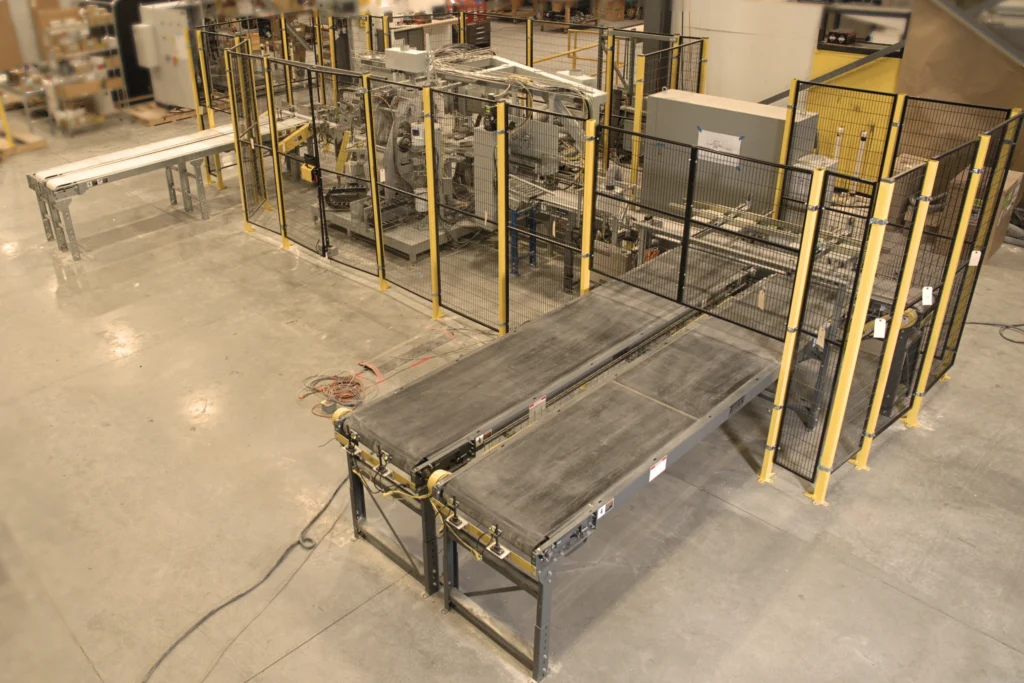
Incoming bricks are densely stacked like dominoes on infeed conveyors. A custom actuator gently tips each brick to horizontal and hands it off to the first processing station.
A quality check station measures every brick dimension before committing it to production. Teh station rejects any brick outside the acceptable range immediately. This alone eliminated a whole class of downstream failures.
A planing station machines each brick to a consistent width, eliminating the dimensional variation that had made stacking imprecise for decades.
Subsequent stations cut the heating element grooves, chamfers, and curves that define each brick’s geometry. The brick moves through these operations held continuously, in a known registered position.
A six-axis Epson robot, selected for its IP69 dust-resistance rating, handles the specialized terminal block grooves and drilling operations that require more complex motion paths. Getting that robot to hold a precise straight-line cut in a high-dust environment required a non-standard approach. Rather than commanding point-to-point moves, the team stitched together a series of very short incremental moves that allowed the robot to course-correct continuously, avoiding singularities and accurately hold the line that quality required.
Drilling stations handle peephole and thermocouple holes before the brick reaches final chamfering and exits the system ready for blow down, printing, and assembly.
The Sequencing Problem
The machine runs a recipe, not a batch. Load a kiln part number, and the machine produces every brick for that kiln in assembly order. Change the part number, and it changes over immediately.
This created a sequencing challenge. Certain bricks, the terminal bricks that require the specialized grooves, take significantly longer to process than standard bricks. There’s one per ring. On an eight-brick ring, processing bricks in strict order creates a bottleneck.
The solution was a look-ahead function that manages sequencing across the line. Terminal bricks are introduced to the machine ahead of schedule. The robot works on them while standard bricks run through the faster stations in parallel. By the time the seventh standard brick is done, the terminal brick that belongs with it is ready. The machine shuffles the input deck and unshuffles it at the output. Assembly order holds while cycle time improves.
The total system comprises approximately 33 axes of controlled motion, including 10 servo drives, 13 variable-frequency drives, four motor starters, and a six-axis robot.
Built to Survive the Environment
Silica dust is hard on equipment. It accumulates in bearings, clogs in socket heads, packs into rail profiles, and finds every gap in a rotating assembly. AMS designed the machine with this in mind throughout.
Labyrinth seals with pressurized air purge protect vertical spindle bearings from dust ingress. V-rails and V-wheels replace profile rails at every linear axis. Dust doesn’t collect on them the way it does on recirculating ball carriages. Additionally, scraper pads on each wheel remove any dust that lands. Hex-head fasteners replace socket-head fasteners across the machine, preserving maintenance access even after months of operation in a dusty environment.
The dust collection system itself was sized and integrated to keep the immediate work envelope clear. AMS fully assembled and ran the machine at our own facility, inside a temporary tent enclosure with a rented industrial dust collector. Everyone entering wore respirators. The test environment gave the team direct experience of what the customers operators faced every day.
System Integration
The machine isn’t an island. It queries the customers ERP system directly, pulling the day’s production schedule from a SQL database and using it to sequence jobs automatically. Operators interact with a simple HMI: select a kiln part number, confirm the run, and the machine handles the rest. If a single brick is dropped or damaged, they can pull up that one brick type and run a replacement without disrupting the queue.
Importantly, AMS designed the machine so that the customers own maintenance team can work on it. That was deliberate.
The Results
Production more than doubled, with half the shifts.
Before this machine, the kiln manufacturer ran two shifts a day, totaling 16 hours, to meet production targets. After commissioning, they run one shift, 8 hours, and produce more than twice as many finished bricks. That’s effectively a 4x improvement in output per labor hour. In their own words: “We can count on this machine to be there every day, which was not the case for the previous machines.”
AMS Eliminated a process built on silica exposure
The machine replaces the manual cutting and grinding operations that put workers in proximity to saw blades and silica dust entirely. The machine handles the work; dust collection manages the environment; the operators interface with a touchscreen.
Inventory overhead and rework dropped substantially.
The kiln manufacturer no longer pre-builds brick inventory by type. In addition, every brick produced is spoken for, already assigned to a specific kiln in the production queue. The machine planes every brick to a consistent height, eliminating the ring-grinding step entirely.
The machine is patented.
Notably, the system design, which is novel in its approach to automated ceramic brick processing, received a U.S. patent. That’s a meaningful signal: this didn’t adapt existing technology; it was an innovative, elegant, purpose-built solution to a problem that hadn’t been solved this way before.
It has become the facility’s signature.
In the words of the customers maintenance team: “This machine continues to be the Disneyland attraction for all of our customers when they tour.” That’s not the outcome we engineered for, but it reflects something real about what happens when a machine works the way it’s supposed to.
About Applied Motion Systems
AMS is a systems integrator and machine builder specializing in motion control, industrial automation, and purpose-built systems for manufacturers across ceramics, paper, glass, wood products, aerospace, and renewable energy.
If you’re facing a production problem that hasn’t found a solution yet, or a safety exposure that your current process wasn’t designed to address, we’d like to hear about it. All of our collaborations begin with an open dialogue.
Key Takeaways
- The first machine effort was necessary, even though it didn’t work to our standards. As a result, the discovery embedded in that initial build, about brick fragility, dimensional variation, and conveyor-based handling, directly shaped the design that succeeded.
- Once you have the brick, never let it go. Continuous positive control from the first quality check to the final chamfer, with the brick always held in a known, registered position, resolved most of the downstream quality problems at once.
- The environment has to be designed for, not worked around. Silica dust isn’t just a health hazard; it’s a machine killer, The choice of labyrinth seals, V-rails, pressurized air purges, and hex-head fasteners throughout reflects a design approach built for reliability and longevity.
- Recipe-driven production eliminated the batch inventory model. The machine produces kilns, not brick types. Every brick that comes out is already assigned to a specific unit in the production queue, and the ring-grinding rework step is gone.
- The sequencing problem was as hard as the mechanical one. A look-ahead function front-loads terminal bricks into the robot station, manages parallel workstreams, and delivers bricks to the output queue in the order of assembly, with throughput optimization as a software engineering problem.
- AMS builds for harsh environments and for the long term. The patented design, the dust-rated robot, the maintainability choices — all of it reflects what the machine needs to look like after years of production, not just at commissioning.
Start the Conversation
All of our collaborations begin with an open dialogue.
More Case Studies
Industry
Technology