
How Applied Motion Systems built a coffee sleeve machine capable of 3,000 sleeves per minute, with reliable print registration at every one

Problem
The customer ran two existing production lines. One did scatter print at 600 sleeves/min. The other did print registration at 60 sleeves/min. Neither could meet volume and quality requirements simultaneously.

Solution
AMS designed a purpose-built coffee sleeve machine from the ground up. It combined dynamic embossing control for print registration with integrated vortex cooling, targeting a design speed of 3,000 sleeves per minute.

Result
One coffee sleeve machine replaced two lines. It met all production requirements on a single shift and delivered the print registration capability the customer had never been able to achieve at volume.
A Pacific Northwest paper converter needed to run pre-printed coffee sleeves at production rates that hadn’t been attempted before.
The mechanical design was solvable. The solution to the thermal problem took longer to find.
The Problem: Two Lines, Neither Doing the Job
The customer ran two insulated, embossed coffee sleeve production lines. The first was a machine they had built themselves, capable of around 600 sleeves per minute but limited to scatter print. No registration capability meant no branded advertising on the sleeves. The second ran pre-printed sheet stock with reliable image placement, but it used a stamping process that maxed out at 60 sleeves per minute. Volume on that line was never going to be meaningful.
What they needed was a single machine that could do both: run pre-printed stock, guarantee that the advertisement landed centered on every sleeve, and maintain a throughput that kept the line viable across a broad range of production requirements.
They asked whether AMS could build it. It would become the first complete production line AMS designed from the ground up; a step beyond controls and software integration into full machine design, mechanical engineering included.
The Solution: The Limit Wasn’t Speed. It Was Glue.
Before specifying anything, AMS set out to understand what was limiting the speed of the existing machine. The controls were poor, but replacing them wasn’t the only answer. The real constraint was adhesive cooling. At high cycle rates, hot melt glue applied to the sleeve bond area didn’t have time to set as the sleeve was folded and crimped. The product popped open after being released from the machine at elevated production rates, and better controls wouldn’t change that.
Working backward from the adhesive’s thermal properties, AMS determined that 3,000 sleeves per minute was the theoretical ceiling. As a result, this became the design target.
Solving the thermal constraint
AMS integrated vortex coolers downstream of the glue station, creating a controlled low-temperature zone over roughly two feet of travel before the fold and crimp rolls. At the typical operating speed of 2,400 to 2,600 sleeves per minute, the bond held. At 3,000, it still held. These cooling zones are what made the elevated production target achievable.
Solving print registration
Registration at speed required solving a process relationship that isn’t obvious until you understand the mechanics: embossing the paper, which gives these coffee sleeves their textured surface, also shrinks it. More embossing force means greater paper shrinkage. If the length of the printed image repeat doesn’t match the rotary die-cutting repeat for the sleeves, images drift off-center and wander. No amount of speed control alone fixes a dimensional mismatch.
AMS’s solution was to use this embossing and shrinkage relationship as a control methodology. By placing the embosser under pneumatic pressure control, the machine could modulate embossing force in real time. It compressed the paper when images ran long and backed off when they ran short. The paper was designed to exit the embosser fractionally shorter than the die repeat. That gave the system something to pull against, keeping registration consistent rather than trying to push it back into place. A Delta Tau UMAC controller coordinated seven axes: the unwind stand, embosser, rotary die, glue application, and the conveyor and pull-apart section downstream. Using registration sensors that detected print position and comparing this to the rotary die captured position, AMS developed an algorithm that effectively solved the print / rotary die registration challenge even with highly variable printed logo spacing on the parent roll.
Details that only showed up at speed
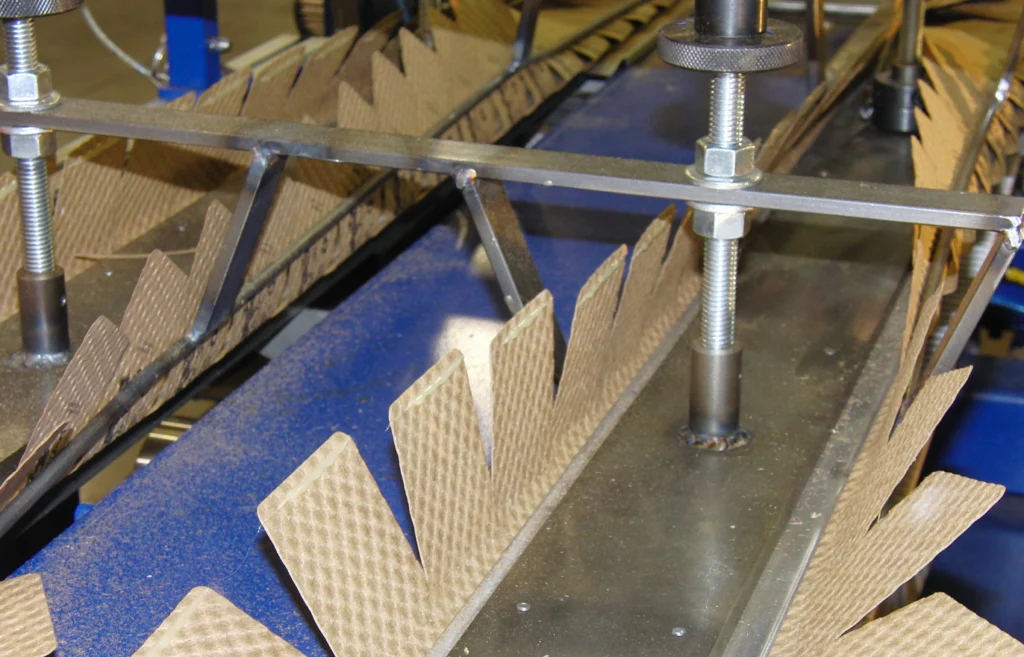
Several challenges emerged that weren’t in the original scope. Cutting kraft paper at that cycle rate generated enough paper dust to require a full dust collection system. The skeleton web, the waste material left after the die cuts out each sleeve shape, needed an integrated vacuum system to manage. The pull-apart and nesting section separated sleeves from a perforated web, shingled them, counted them, and grouped them for packaging. Coordinating conveyor speeds, a counter, and a motion-controlled gap kept the packaging team downstream supplied at a workable rate.
AMS fully assembled and ran the machine at its facility before shipping. The team ran multiple rolls of production material through it, resulting in a successful Factory Acceptance Test.
The Results: A Machine That Performed Well Enough to Make a Second Production Line Unnecessary
The new machine replaced both existing lines. At the typical operating speed, it exceeded their combined output and delivered print registration accuracy that neither line could achieve at any speed.
The customer had anticipated that a successful build would lead to a follow-on order for a second machine. It didn’t. Instead, the first machine has run fast enough to meet production capacity, and scaling output was only a matter of adding a shift or two a week.
Two lanes, producing 2,400-2,600 sleeves per minute with precision glue placement on every cycle. The glue supplier, familiar with the limits of their own control hardware, was surprised it could be managed that precisely at that speed.
Technologies
- Delta Tau UMAC multi-axis motion controller w/ Seven-axis servo control architecture
- Nidec AC Vector and Brushless Servo Drives
- Pneumatically regulated dynamic embossing for real-time print registration
- Vortex cooler integration for adhesive thermal management
- Rotary die and sandwich conveyor system
- Automated pull-apart, nesting, counting, and gap-controlled output section
- Nordson hot melt adhesive system
About Applied Motion Systems
AMS is a systems integrator and machine builder. Our work spans motion control and industrial automation across paper converting, web handling, glass containers, aerospace tooling, renewable energy, and applications most companies haven’t tried before.
We start by learning the process: the machine, the material, the environment, and the constraints that govern how the system needs to work. We design for the environment the system will operate in, and we think about what it looks like years after commissioning, because that’s when building it right becomes obvious.
If you are working on a custom machine problem where the limiting constraint isn’t obvious from the outside, we would welcome the opportunity to work through it with you.
Key Takeaways
- The limiting constraint was thermal, not mechanical. The line wasn’t slow because of poor controls. Hot melt adhesive needed time to set before the sleeve could be crimped. Vortex coolers integrated into the line solved it.
- 3,000 sleeves per minute was derived from physics, not ambition. AMS worked backward from the adhesive’s thermal properties to establish the speed ceiling, then designed to reach it.
- AMS solved print registration by treating embossing as a control input. Pneumatic pressure control over the embosser gave the system a real-time mechanism to keep the printed image aligned with the rotary die at full speed.
- Challenges that only appear at speed have to be engineered for in advance. Paper dust, skeleton web management, and pull-apart sequencing were not in the original scope. Full factory acceptance testing with production material found and resolved them before the machine shipped.
- The machine performed well enough that a second one was never ordered. One machine running at 2,400 to 2,600 sleeves per minute satisfied production capacity across both lines it replaced. It also delivered print registration that neither line could achieve at any speed.
Start the Conversation
All of our collaborations begin with an open dialogue.
More Case Studies
Industry
Technology