
Our Automation Engineering Process
We have designed our industrial automation engineering process to deterministically produce robust, tailor-made solutions to your manufacturing challenges. In this collaborative approach, we seek mutual understanding between all project stakeholders. Early alignment on key features and capabilities reduces risk and accelerates through machine building and integration. Each phase is a paid engagement that solidifies the concept, streamlining and informing the next. The outcome is a machine that meets your production requirements and delivers ease of ownership for its entire service life.
Concept Development
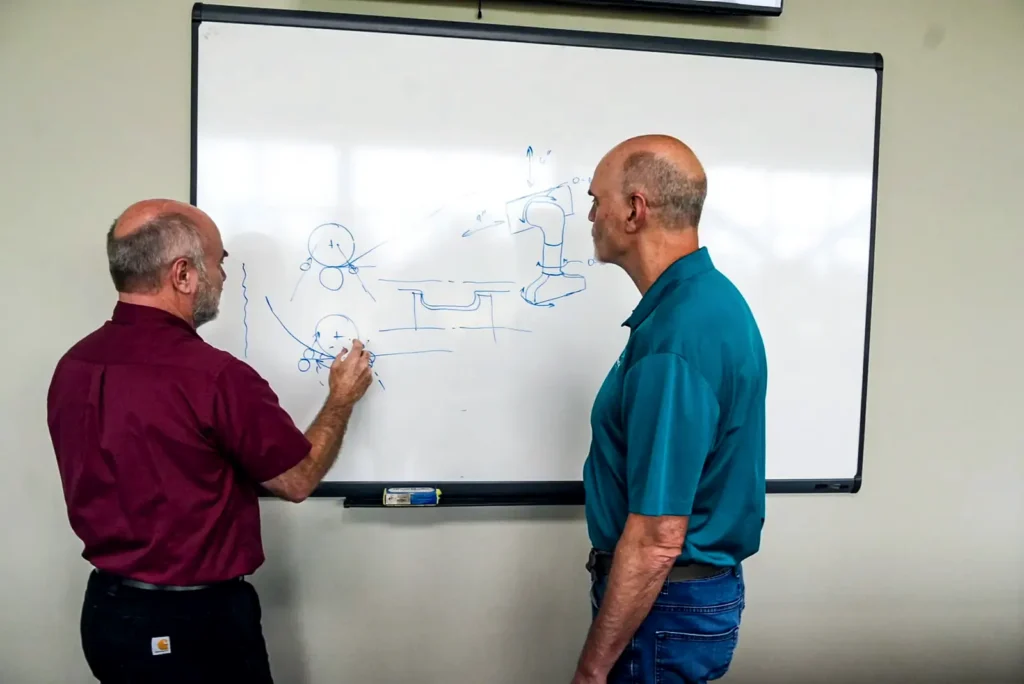
Sound ideas start with shared understanding. We begin by asking thoughtful questions, challenging assumptions, and listening carefully for concerns, risks, and opportunities. By broadening our definition of the problem, we can explore all possibilities in a realistic way. We develop multiple concept options, enabling all stakeholders to determine the direction of viability testing.
This phase is a stand-alone, paid time and materials engagement. Scope typically ranging from 80 hours for a simple machine to 200 hours for a complex one. Deliverables include a machine concept, high-level project scope and requirements, identified risks, and a budgetary estimate and schedule for the next phase.
Concept Refinement
The partnership expands in this phase as we bring together more members of our team and yours and test concepts identified in Phase 1, share test results, summarize findings, and invite feedback. This lets us identify risks, develop mitigation plans, and engage in an exchange of ideas that promotes long-term reliability. With concept, scope, and requirements refined, we have a clearer budget picture and are ready to order long-lead components and advance the machine design.
Design
We continue to engage your team through design, discussing feature options and refinements as we optimize the machine configuration for your needs. We discuss design variations with an eye toward process flow, efficiency, safety, ergonomics, ease of maintenance, spare parts commonality, and economics. This discussion establishes common expectations and understanding between your team and ours. Together we narrow from all possibilities to what is essential, seeking a machine well suited for its production role. From here, we have a firm foundation and fixed price budget to proceed with manufacturing your solution.
Build
At this stage, the build phase benefits from the deep involvement and understanding the build team has developed to this point. Mechanical, electrical, and systems engineers join fabricators, machinists, and technicians to uncover final opportunities to simplify the build. Each perspective helps streamline how we bring the concept to life. The result improves the odds of a successful outcome as the machine reaches production readiness.
Factory Acceptance Test
We invite members of your team to join us and view the machine in operation in our facility. Beyond running the machine in production conditions, our team shares insights on operating and caring for the system in your environment. We also begin training operators and maintenance technicians in best practices, discussing and implementing improvements that enhance usability and efficiency. We bill this phase at time and materials rates, varying by machine complexity and the number of production tests in the FAT agreement.
Installation to Start-Up
When the machine arrives at your plant, our team joins yours through installation, commissioning, start-up, Customer Acceptance Testing, and training. This is the final T&M engagement. We work with your team to streamline machine integration with upstream and downstream equipment, maximizing the operating window for the production line and connection with your plant network. Working side by side with your operators and technicians, we ensure a complete technology transfer. When our team leaves, your team is fully equipped to support the system confidently.