
Engineered Wood Products Automation Integration
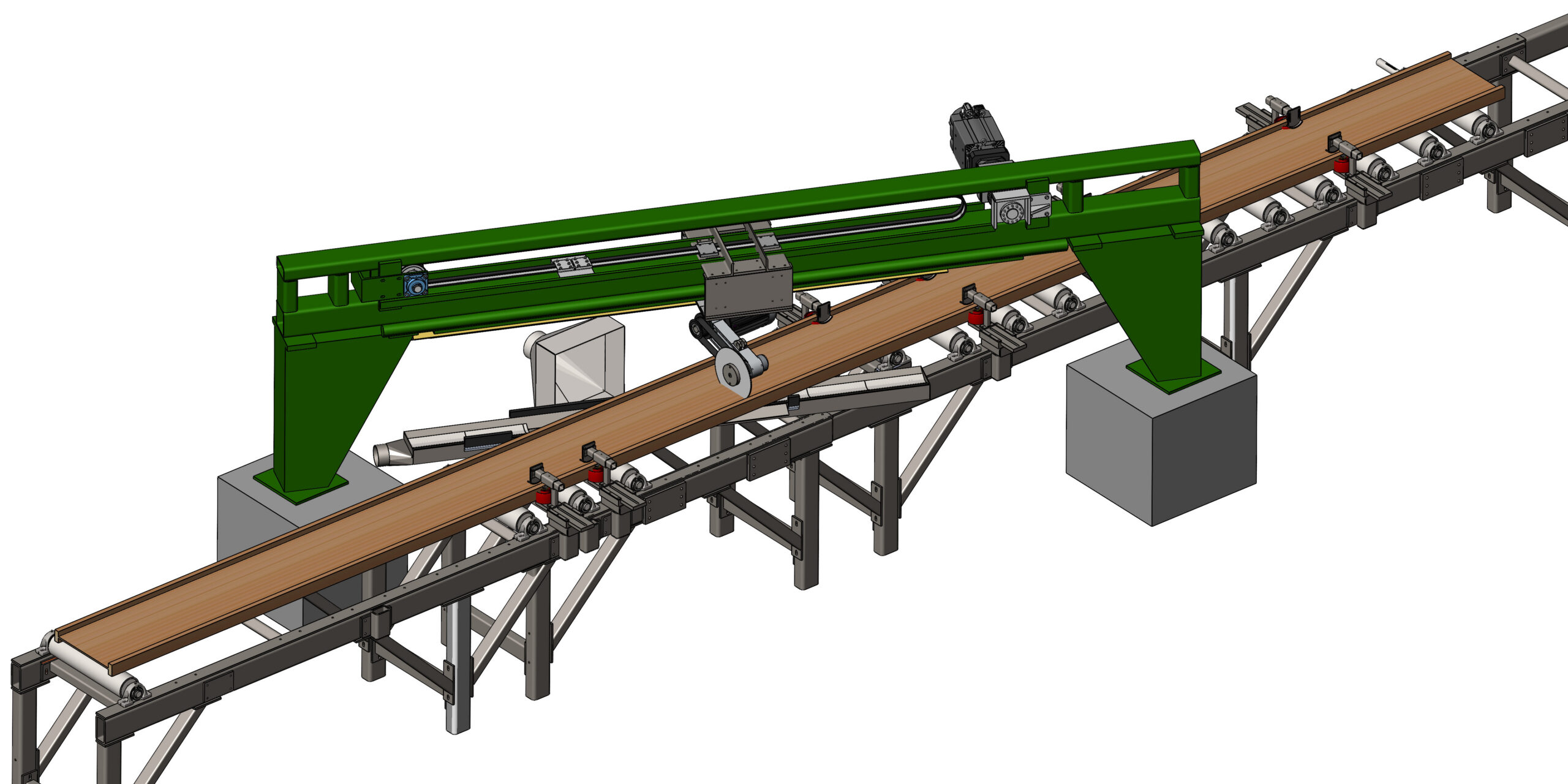
Engineered wood products facilities are among the most demanding environments for industrial automation. Heat, wood dust, high-cycle operation, and continuous press schedules create conditions that often eliminate off-the-shelf approaches before the first site visit is over. On one particular LVL layup line we updated, an hour of unplanned downtime didn’t merely cost time; it cost $50,000. On a veneer knock down station, a pneumatic actuator that worked fine six months ago is now inconsistent, creating quality problems at subsequent stations downstream.
AMS is an industrial automation integrator that has worked specifically in engineered wood products since the mid-1990s. Our work spans LVL layup and billet manufacturing lines, I-joist manufacturing, finger joint lines, and veneer processing operations. We understand these processes: the continuous press sequences, veneer sheet placement accuracy, and flying saw coordination. We also know the mechanical wear patterns that surface after years of high-cycle operation in a hot, dirty environment.
Industrial Automation Integration for Engineered Wood Products
The problems we are called in to solve are consistent across EWP facilities: a customer wants more production throughput, improved quality consistency, or obsolescence mitigation for a control system that has reached the end of its serviceable life. The solutions are rarely the same. Each one is built around the specific machine, environment, and constraints of that facility.
LVL and Billet Manufacturing Lines
LVL and structural billet lines share the same fundamental challenge: moving veneer sheets through a precisely sequenced layup process, including gluing, staging, interleaving, and pressing, fast enough to keep the continuous press running without errors in the mat. The billets that come out become headers, large beams, and the narrow flanges ripped for I-joist upper and lower cords. Consistency in the layup directly determines the structural integrity of the products that are made from it.
Most of the layup lines we’ve worked on were producing product, yet problems abounded. These layup lines were limited by control systems that lacked consistent veneer position data. A line running on photo eyes and timers can only go so fast. Uncertainty in sheet position forces conservative delays that compound across every axis. Replacing that timing-based logic with encoder-informed, position-based coordination provides the motion-centric foundation of every optimization we’ve done on these lines.
On one major LVL layup line, AMS paired the controls change with a full mechanical overhaul. Specifically, that meant new elevator systems, new drivetrains, redesigned tipples, and a drop-corner section with linear motors. The result was a line running at 27 feet per minute across 89 coordinated axes, a 20% increase in throughput with dramatically improved lap-to-lap consistency. The payback period came in around four months.
Finger Joint and Continuous Press Lines
Finger joint lines and continuous press operations run near their mechanical limits by design. Flying saws cut at full production speeds because slowing the line to cut is not an option. The press doesn’t stop, and the systems feeding it can’t introduce variability. Every axis upstream should run with enough precision to ensure that what enters the press is perfectly positioned with optimum sheet lap and perfect zero line.
Veneer Processing and Sheet Sequencing
Veneer processing systems are where motion control failures show up most visibly: misaligned sheets, downstream quality problems, and stacking errors that cascade through the line. This is also where the environment is hardest on equipment. Heat, wood debris, and continuous impact loads degrade pneumatic actuators predictably. Seals fail, end-stop behavior becomes inconsistent, and positioning drift produces veneer skew and lamination defects.
In one engineered lumber facility, AMS replaced pneumatic cylinders on a veneer placement system with Iris Dynamics ORCA smart linear motors. The pneumatic actuators had degraded in the hot, dirty environment, losing actuation consistency and causing misalignment and downstream quality problems in the lamination process. The linear motors delivered immediate improvements: better belt alignment, reduced veneer skew, and more precise sheet placement. Overhang in finished stacks was all but eliminated, reducing material damage during forklift transfer.
The integration requirement mattered just as much. The facility’s controls team had one non-negotiable: any new motion technology had to work within the existing Rockwell ControlLogix environment. No separate software. No tools the plant’s electricians didn’t already know. AMS integrated via EtherNet/IP, giving plant personnel full control from within the programming environment they were familiar with. Electricians create and modify motion profiles on the fly from within the PLC, with no additional software required.
I-Joist Manufacturing Lines
I-joist manufacturing brings together the upstream LVL work and web handling challenges on a single line. The LVL flanges cut from the layup line are routed, glued, and assembled with oriented strand board web sections, with each web finger-jointed and fed continuously through the line. Web feeding systems must maintain consistent force and position to ensure no gap in the web and no wasted material. Motion and force control has to fit the specific line speed, material, and feed geometry. Consistent flange dimensions coming off the LVL line, accurate web feeding, and precise assembly sequencing all have to work together. AMS has worked both sides: the LVL lines that produce the flange stock and the I-joist assembly lines that consume it. Once the joist is assembled, we cut it accurately, on the fly, at line speeds up to 1000 fpm.
The Environment Is Part of the Engineering Problem
EWP facilities serve up heat, wood dust, and continuous impact loads to equipment, and these are the baseline conditions that systems have to perform in, day after day. Equipment that works well at commissioning is a good start. Equipment that works after years of this abuse is what defines success.
Getting inertia matching right, eliminating wear mechanisms from mechanical subsystems, and selecting motion technologies suited to this challenging environment are tasks that create solid foundation on which to build. The veneer stacker project is a clear example: pneumatics were the wrong technology for that environment. The answer wasn’t to replace them with better pneumatics; instead, it was to understand why they were failing and specify something that wouldn’t and do this in a way that the plant personnel could easily integrate into their workflow.
How We Work as Industrial Automation Integrators
As industrial automation integrators, we want to know as much as possible about a customer’s plant and production process before we begin. This means understanding the press schedule, the veneer grade mix, the duty cycles on individual axes, and the maintenance history of the mechanical systems. The control problems and mechanical problems are almost always connected. Solving one without the other leaves system reliability and throughput on the table.
On a recent LVL layup project, AMS engineers spent weeks inside the machine before the controls work began. They cataloged wear in the elevator systems, identified undersized actuators, and designed mechanical upgrades that went to fabrication before the software rewrite began. The drive and control system optimization delivered what it did because the mechanical foundation was rebuilt first.
All of this rework was done with the operator on shift and the electrician on call in mind. HMIs are designed for someone to read at a glance, alarm structures that point to the root problem, and software written so the maintenance team can troubleshoot it with ease.
From the Field
Veneer Stacker Automation — Pneumatics Replaced with Smart Linear Motors
Pneumatic cylinders controlling veneer placement had degraded in a hot, dirty production environment, resulting in inconsistent positioning and downstream quality issues. AMS replaced them with Iris Dynamics ORCA smart linear motors, integrating natively with the existing Rockwell ControlLogix infrastructure, with no separate configuration software needed.
LVL Layup Line Optimization — From Timers to Position Control
A major engineered wood producer’s LVL layup line was running blind, relying on photo eyes and timers that couldn’t keep pace with production demands. As a result, AMS redesigned the control architecture, eliminated production bottlenecks, and deployed changes live on a running press. Downtime came in at a costly $50,000 per hour. The result was a 20% increase in throughput across 89 coordinated axes, with a 4-month payback.
Key Takeaways
- We understand EWP machinery. AMS has worked in LVL layup and billet manufacturing, I-joist lines, finger joint and continuous press operations, and veneer processing since the mid-1990s.
- The real leverage is position-based coordination. An encoder-based, position-informed control system changes what the line is capable of. On a recent LVL layup line upgrade, this foundation delivered a 20% throughput increase with a four-month payback.
- The environment is part of the engineering problem. Heat, wood dust, and continuous impact loads are an ever-present challenge in EWP. We select and design with this in mind, delivering high reliability and production consistency for the long haul.
- We start with mechanical engineering to establish a solid foundation on which to build. We evaluate drivetrain inertias, system backlash, and positioning wear mechanisms to ensure software updates have the greatest possibility of success. On every LVL, I-joist, and press optimization project, mechanical analysis and updates came before the software rewrite. That foundation made the throughput gains possible.
- We design the system so your team can support it with ease. HMIs built for operators reading at a glance, diagnostics that point to the root problem, and control software written so your maintenance team can troubleshoot it using the technology tools they already know.
Let’s Talk About Your Machine
Engineered wood products lines are specific. So are we.
If you’re running a layup line that’s being held back by conservative delays built around positioning uncertainty, dealing with veneer handling inconsistency you haven’t been able to trace to a root cause, or looking at a drive system that’s reached the end of its serviceable life, we’d like to understand your production need.