
LVL Layup Line Optimization — Motion Control Case Study

Problem
A continuous LVL layup line was running below capacity because timer-based controls couldn’t tell the system the precise location of any particular sheet.

Solution
AMS replaced the drive and control architecture with encoder-based position feedback, redesigned key mechanical systems, and deployed all changes live against a $50,000/hour downtime cost.

Result
The line reached 27 feet per minute across 89 axes of coordinated control, with a return on investment of approximately four months.
How Applied Motion Systems redesigned the control architecture of a major engineered wood producer’s LVL layup line to dramatically increase throughput, without stopping the press
The Problem: A Line Running Blind
Laminated Veneer Lumber is one of the structural workhorses of modern mass timber construction and I-Joist manufacturing. A single LVL beam can span 120 feet. Making one requires moving thousands of veneer sheets per hour through a precisely sequenced layup process — gluing, staging, stacking, and pressing — with each sheet landing exactly where it needs to be.
The line wasn’t doing that. A direct result of a control system that relied on photo eyes and timers. A sheet would break a sensor beam, and some fixed interval later, the system would tell a drive to stop. The drive would decelerate and eventually come to rest, somewhere. Where exactly was never certain. There was no encoder feedback, no position data, and no way to know where any sheet was with any level of precision at any given moment.
The consequences showed up as throughput and quality. Without knowing position, the system built in conservative delays to compensate for the uncertainty. Those delays compounded across every axis on the line. Furthermore, speeding up meant higher variability, which adversely affected quality. The press, the heart of the operation, running continuously, was being starved by a control system that couldn’t keep up with it.
Downtime at the press cost $50,000 per hour, and any fix would have to happen while the line was in production.
The Solution: Position Control and a Full Mechanical Overhaul
AMS had worked with this customer often, supporting their veneer peeling operations upstream. That history meant AMS understood how the raw material was made before it ever reached the layup line, and it gave both teams a foundation of trust to take on something harder.
The first thing AMS did was to take a deep dive into the existing process and machinery supporting it. Engineers spent weeks inside the machine cataloging what was wrong: worn elevator designs, undersized half-roll actuators, and chain systems absorbing stress they weren’t built to handle. A mechanical upgrade proposal came before any discussion of controls. AMS designed and fabricated new drivetrains, counterbalanced elevators with air receivers to reduce forces and wear, and redesigned tipples for accuracy and throughput, all equipment designed and fabricated at AMS and shipped to the mill.
Live Deployment Against a $50,000/Hour Clock
Then came the control system. AMS replaced the entire drive and PLC system in stages and added encoder feedback to every axis. For the first time, the line knew where every sheet was. AMS rewrote the software from the ground up to exploit that position data for a motion-centric foundation rather than a timing/sequence based foundation: staging sheets accurately, minimizing dwell time, and moving material through the line as fast as physics allowed.
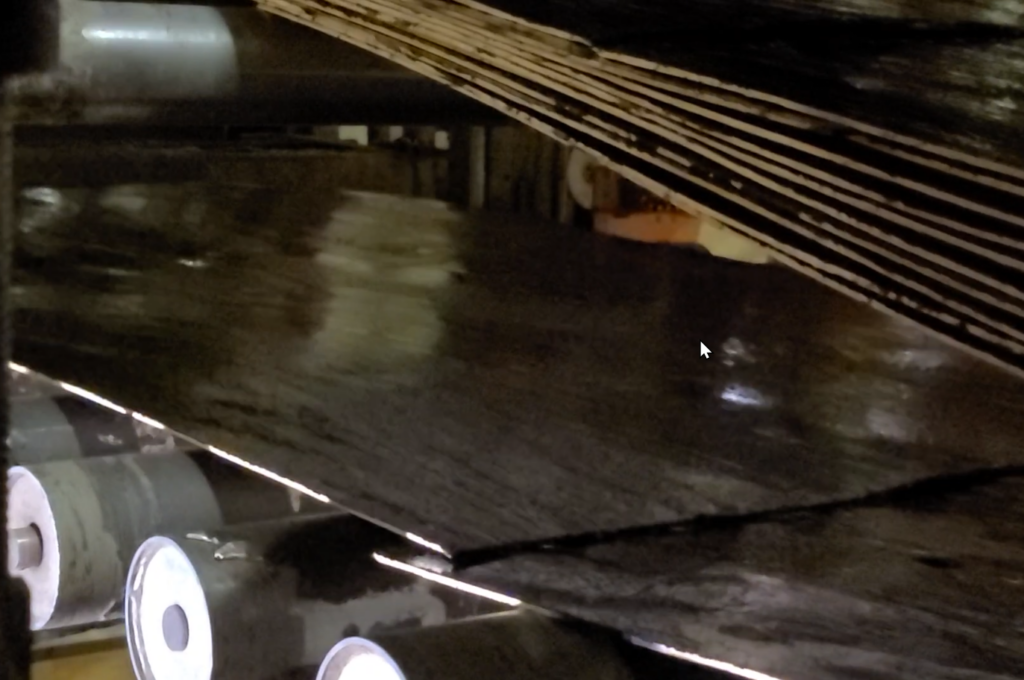
A new drop-corner section was designed with linear motors to facilitate a right-angle transfer. AMS enabled sheet tracking with laser scanning of leading and trailing edges for skew correction. A precision indexing system spaced sheets into fans of up to 24 pieces, timed to interleave with the fan ahead — like two decks of cards neatly nesting together. The result was a mat of 16 to 32 plies, positioned on the previous mat and ready for the top sheet and then on into the press.
Because the press ran continuously, the team had to deploy every code change live. The team inserted small sections, tested them, and pulled them back out if they didn’t perform as desired, all without breaking the continuous billet moving through the press.
The Results: What Changed
The line now runs at 27 feet per minute across 89 axes of coordinated control — a full 20% throughput increase, with lap to lap consistency improved dramatically. The payback period came in around four months, with the dollar figures behind that math running into the millions.
The engagement didn’t end at commissioning. The customer’s satisfaction with the project led directly to them naming AMS as the Control System Partner for an ongoing I-joist line upgrade at the same facility. This downstream application uses LVL cut from the same line as the upper and lower flanges of each joist.
What Made It Different
Timers controlled the line because that’s how the industry had always run these lines. Replacing timers with position feedback sounds straightforward. In practice, it required replacing the entire conceptual model of how the line worked, not just the hardware.
AMS also didn’t separate the mechanical problems from the control system problems. The two were intertwined, and solving one without the other would have left throughput on the table. Crawling through the machine, cataloging everything wrong, and fixing it all — mechanical and electrical, hardware and software — is what made the optimization possible.
The live-deployment constraint built a discipline most integrators don’t develop: improving a running system incrementally, with real consequences for getting it wrong and a clear plan for getting it right.
Technologies
- Encoder-based position control with motion planning replacing timer-driven logic
- Linear motors (drop-corner section) for low maintenance, high reliability sheet transfer
- Laser edge scanning and active skew correction, maintaining orthogonal sheet orientation from bin to press
- Full servo drive architecture replacing legacy drives
- Counterbalanced elevator systems with air receivers to dramatically reduce maintenance and power requirements
- Custom tipple and conveyor equipment designed and fabricated by AMS to facilitate accurate sheet placement and higher throughput
- Microwave pre-cure and rolling press integration to optimize board quality
About Applied Motion Systems
AMS is a systems integrator and machine builder. Our work spans motion control and industrial automation across paper converting, web handling, forest products, aerospace tooling, renewable energy, and applications most companies haven’t tried before.
We start by learning the process: the machine, the material, the environment, and the constraints that actually govern how the system has to work. We design for the environment the system will actually operate in, and we think about what it looks like five years after commissioning, because that’s when building it right becomes obvious.
If you are working through a motion control or automation challenge in a demanding environment, we would welcome the opportunity to discuss it with you.
Key Takeaways
- The line was running blind. Timer-based controls had no position feedback, so the system compensated with delays that compounded across every axis and capped throughput.
- We started with the machine, not the code. The team identified and fixed mechanical problems — worn elevators, undersized half-shafts, failing drivetrains — before writing any software.
- The team deployed all upgrades live. With press downtime costing $50,000 per hour, every control change had to be tested, validated, and reversible — without adversely impacting production.
- Position feedback changed everything. Replacing timers with encoder-driven control across 89 axes gave the line accurate sheet placement for the first time and unlocked a line speed of 27 feet per minute. A 20% production throughput increase in addition to improved lap accuracy and associated fiber savings / improved board quality.
- The ROI came in around four months. The engagement expanded directly into a follow-on I-joist line upgrade at the same facility.
Start the Conversation
All of our collaborations begin with an open dialogue.
More Case Studies
Industry
Technology