
What Is a SCADA System?
SCADA Systems: Turning Mold Cooling Into a Measurable Process
Among the many opportunities AMS has had to deploy SCADA technology in manufacturing facilities, few have had as much operational impact as a system installed for one of the largest glass container manufacturers in North America.
Glass container manufacturing is an energy-intensive, tightly coordinated process. Molten glass moves from the furnace through an individual-section, or IS, machine, where it is metered, sheared into gobs, formed into containers, and transferred into an annealing oven. A typical melting furnace can process up to 20 tons of glass per hour, and consistency matters at every stage.
One important source of variability is mold cooling. A typical cooling system uses a large fan and ductwork to deliver air to the IS machine. In the plant AMS worked with, airflow had traditionally been controlled by a manual damper. Operators watched the machine, assessed its operation, and adjusted the damper based on experience.
That approach had two drawbacks. First, it depended on individual judgment. Different operators made different adjustments under similar conditions, and the resulting variation in cooling airflow affected mold temperatures, container quality, and production yield. Because the process was open-loop, the plant had no reliable, data-driven way to determine the airflow that produced the best result for a given product, machine condition, or production rate. Second, it was inefficient. The fan ran at full speed around the clock while a damper restricted airflow to match demand. As a result, the plant paid for maximum fan output whether the process needed it or not.
The customer needed more than a better way to adjust a damper. They needed to measure cooling performance, optimize fan speed, retain operating data, and make that information visible across the plant and across multiple facilities. That is where SCADA became part of the solution.
How a SCADA system works
SCADA stands for Supervisory Control and Data Acquisition. A SCADA system collects data from equipment and control systems, displays real-time operating information, records historical data, manages alarms, and gives plant personnel a higher-level view of operations. In practical terms, SCADA helps answer questions such as:
- What is happening across the plant right now?
- Which machine or process is approaching an alarm condition?
- How did a process perform over the last shift, week, or month?
- What operating conditions produced the best quality and yield?
- Is one plant performing differently from another?
In practice, SCADA is often described as the supervisory layer of industrial automation. It does not replace the PLCs that perform the fast, local control required to run equipment safely and reliably. Instead, it connects equipment and controllers into a broader system for monitoring, alarming, trending, reporting, and supervisory control.
For the glass manufacturer, this meant the mold-cooling system stopped being just a fan, a damper, and an experienced operator making adjustments by feel. It became a measurable process, with documented performance, closed-loop control, and plant-wide visibility.
What’s the risk of not having a SCADA system?
Without a SCADA system, many problems become apparent only after they’ve already affected production, product quality, maintenance cost, or energy use. An operator may notice that a machine doesn’t sound right or that quality is beginning to drift. Still, without historical data and plant-wide visibility, that’s hard to pin down. The issue could be isolated, recurring, tied to a particular product run, or connected to an upstream condition.
In effect, SCADA turns isolated observations into usable operational information. It records trends, compares performance between shifts or lines, flags recurring alarm conditions, and gives maintenance teams early warning of developing equipment issues. That matters most in environments with high temperatures, high energy loads, pressure, or continuous production demands. In those settings, a delay in spotting a developing condition can mean lost product, unplanned downtime, or avoidable equipment damage.
In glass manufacturing specifically, cooling consistency directly affects the forming process. A SCADA system doesn’t replace experienced operators or process knowledge. It gives those people better information and a way to apply that knowledge consistently, shift after shift.
SCADA versus DCS: Which solution is best for your plant?
SCADA and DCS (Distributed Control System) both give you visibility into your operation, but they’re usually applied to different kinds of control problems.
SCADA is a good fit for manufacturers connecting multiple machines, lines, utility systems, or facilities. It’s especially useful where supervisory control, centralized alarming, historical data, remote access, and visibility across equipment from different vendors are the priority. DCS is generally built for a large, continuous process that requires tightly integrated, highly available control. It shows up most often in industries like chemical processing, oil and gas, power generation, and pulp and paper.
The choice isn’t always either-or. Modern systems can overlap in capability, and the right architecture depends on the process, risk level, installed equipment, and expansion plans. For a manufacturer improving visibility across discrete production equipment, or scaling a proven control approach across multiple plants, SCADA is usually the more practical path. From there, we can walk through the tradeoffs for your specific operation.
SCADA versus PLC and HMI
PLC, HMI, and SCADA are related technologies, but they serve different roles.
A programmable logic controller, or PLC, is the controller closest to the equipment. It reads sensor inputs, runs the machine logic, and commands motors, drives, valves, actuators, and other field devices. In a cooling application, the PLC monitors airflow, pressure, fan speed, guide-vane position, and equipment status while continuously adjusting the system to meet its targets.
A human-machine interface, or HMI, is the operator interface: a touchscreen mounted on a machine or an operator workstation that displays machine status, alarms, settings, and controls. It lets an operator understand and interact with one machine, line, or process area.
By contrast, SCADA works above those layers. It gathers information from multiple PLCs, HMIs, machines, and facilities, and provides centralized alarms, historical trending, reporting, remote access, and a common view of operations. Put simply: the PLC controls the equipment, the HMI helps an operator run the equipment, and SCADA helps the organization understand how the larger operation is performing.
Questions to ask before investing in a SCADA upgrade
Start with what you’re trying to monitor: a single process, a whole plant, or a network of plants. That answer, more than any general rule, determines whether SCADA, a simpler HMI, or a DCS is the right fit. We’ll tell you honestly if a simpler solution will do the job. Ultimately, the goal is the right architecture for your operation.
How AMS applied SCADA to mold cooling
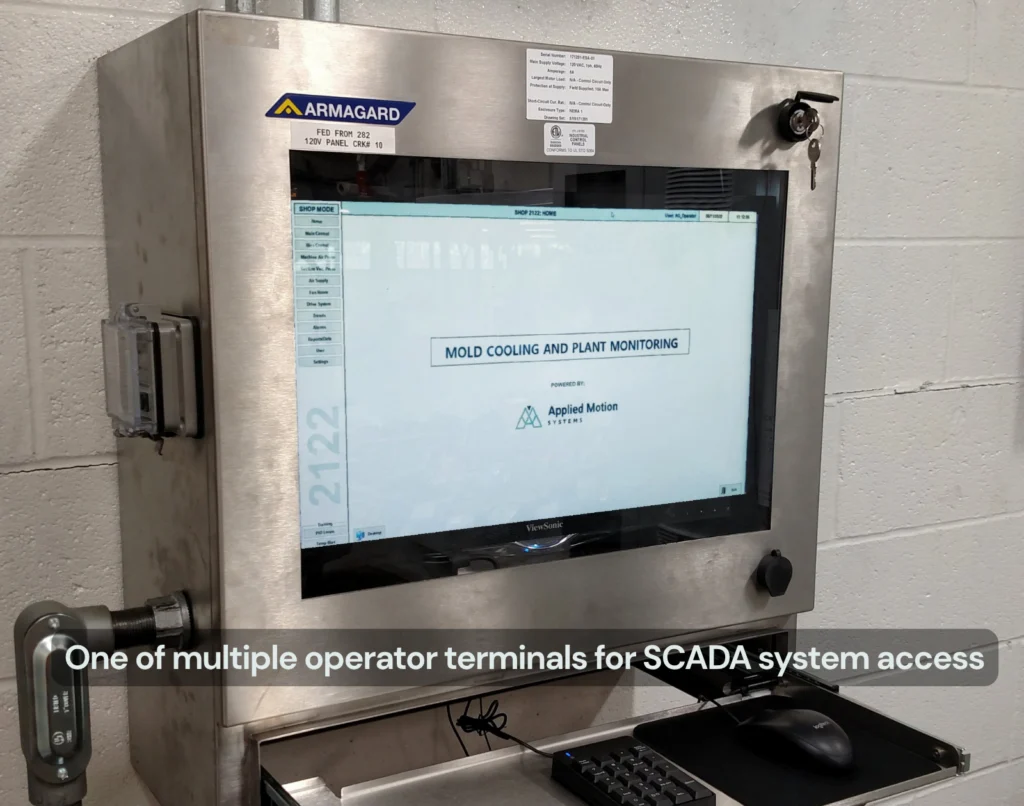
AMS replaced the manual cooling approach with a closed-loop mold cooling and plant SCADA system. The project included a variable-speed 450 hp fan, motion-controlled inlet guide vanes, continuous three-axis bearing monitoring, Rockwell controls, and an InduSoft-based SCADA platform. Instead of running the fan at full speed and throttling airflow with a damper, the system adjusts fan speed directly based on actual process demand. The system continuously monitors IS machine operating conditions and adjusts fan speed based on the number of active sections, ambient air conditions, humidity, and measured temperatures within the machine.
Local, time-sensitive decisions for running the cooling equipment still happen at the PLC level. Above that, the SCADA platform adds trending, alarm management, historical data, remote access, and a consistent view of performance across multiple plants.
As a result, cooling consistency improved, along with container quality and yield. Energy savings followed, and maintenance shifted from reactive to scheduled, based on actively monitored equipment condition. The customer also earned Energy Star certification. What began as a single-plant project has since grown into a multi-plant platform.
If you’re trying to get visibility into one machine, one plant, or a network of plants, we’d be glad to talk through what that would take.
Key Takeaways
- SCADA stands for Supervisory Control and Data Acquisition. It gives plant personnel a higher-level view of operations: real-time status, historical data, trending, and alarm management across machines, processes, or facilities.
- SCADA is a supervisory layer, not a replacement for PLCs. The PLC runs the equipment, the HMI helps an operator run it, and SCADA helps the organization understand how the larger operation is performing.
- DCS and SCADA solve different problems. SCADA fits manufacturers connecting multiple machines, lines, or facilities. DCS fits a single, continuous process that needs tightly integrated, highly available control.
- A real-world example: a glass container manufacturer replaced manual, damper-controlled mold cooling with a closed-loop SCADA system, improving yield, cutting energy use, and shifting maintenance from reactive to scheduled, resulting in Energy Star certification.
- Not every plant needs a SCADA system. The right starting question is what you’re trying to monitor: one process, one plant, or a network of plants.