
Card Sorting Machine for a Trading Card Distributor

Problem
Demand for a popular trading card game surged, and the customer couldn’t train graders fast enough. Becoming a master grader takes several months of training, and they needed a faster solution.

Solution
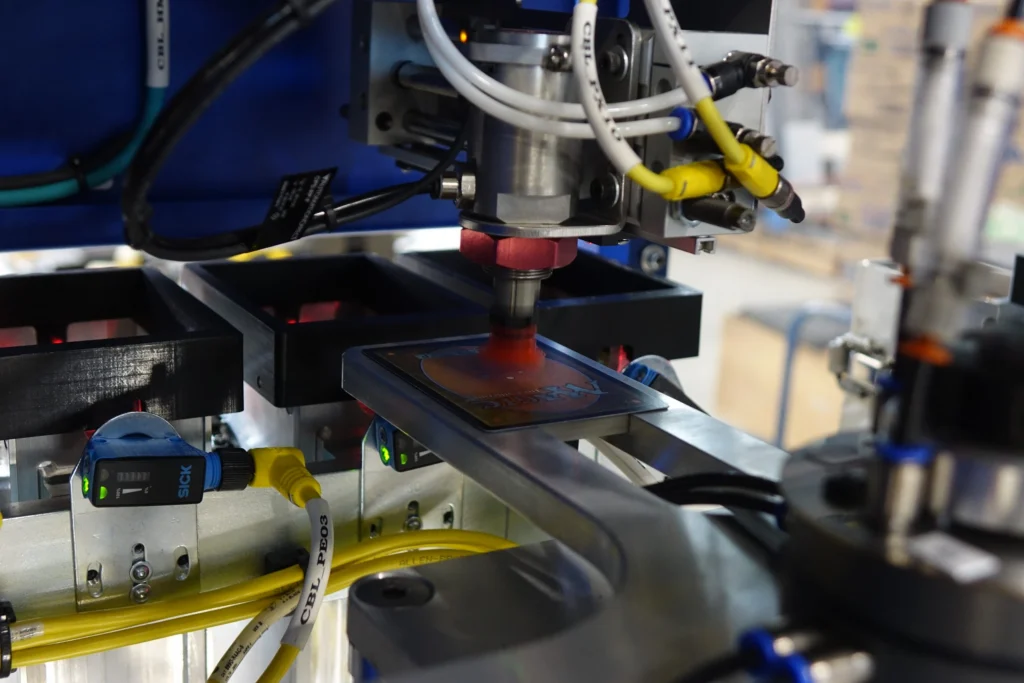
AMS designed a machine that singulates cards, presents both sides to the customer’s inspection system, and sorts each card by grade while avoiding card damage. A custom set of vacuum ports integrated into two star wheels holds each card as it transfers between them.

Result
A machine that met throughput targets while handling cards without imparting damage of any kind, verified by the customer’s master graders during factory acceptance testing.
How AMS created a card sorting machine that singulates and sorts high-value trading cards without damaging them
The Problem: More volume than the grading team could keep pace with
A trading card distributor buys, grades, and sells cards for a popular trading card game. A card’s condition plays a big part in assigning its value, so master graders inspect every card by hand. These graders train for several months before they can assess a card reliably. When demand for the game surged, the customer could not train graders fast enough to keep pace.
Automating any part of that process meant handling every card without leaving a mark. The customer processed cards worth a few dollars alongside cards worth tens of thousands of dollars, and the machine had to treat each one identically. A scratch that lowers a card’s grade also lowers its resale value, so a single damaged card would cost the customer revenue.
The Solution: A handling and sorting machine built around an innovative inspection system
After evaluating off-the-shelf card graders, the customer developed its own inspection system with its suppliers, combining Keyence cameras with a structured-light 3D scanner. What remained was the mechanical problem of moving cards through it at required processing rates. The machine had to pick each card from a magazine and present both faces to the sensors. It then had to route the card to the correct output magazine by grade. That card grading and sorting machine became the AMS scope.
How it Works
An operator loads a stack of cards into an infeed magazine. Processing each card involves a well-choreographed sequence. Follow one card through the process.
- A specially designed vacuum pad lifts the top card from the infeed magazine and transfers it to an underside station on a four-position star wheel. A slight vacuum holds the card in place.
- The star wheel indexes 90 degrees. A simple fixture realigns the card so it sits squarely on the underside of the star wheel.
- The star wheel indexes another 90 degrees, and the Keyence vision system takes an image of the card. System software evaluates the image.
- The star wheel indexes another 90 degrees, and the card is now aligned over a second star wheel. A slight puff of air replaces the vacuum on the first star wheel. At the same time, the second star wheel applies vacuum to its top side. The card transfers from the first star wheel to the second, which now holds the card on its top side.
- The second star wheel indexes 90 degrees. The vision system images the second side of the card, and system software evaluates it.
- The second star wheel indexes another 90 degrees, and a laser makes a 3D scan of the card. With all surface and image data evaluated, the system makes a grade judgment.
- The second star wheel indexes a final 90 degrees, presenting the card to a linear actuator. The actuator deftly picks the card up and places it in one of five bins according to its grade.
AMS designed custom vacuum transfer ports for both star wheels. A stationary vacuum supply feeds each wheel, and the ports open and close mechanically as the wheel indexes, so the transfer sequence operates without electrical valves. The infeed and outfeed magazines are interchangeable, and each one has a floating bottom positioned by an electric actuator for optimum card pick and place operations. On the infeed side, the actuator raises the stack incrementally as cards are removed. On the output side, it lowers the stack as cards accumulate. Operators load and unload every magazine from the same side of the machine.
Picking one card at a time
Singulation presented one of the more difficult engineering problems. The cards tend to adhere to one another, so a single pick could lift two or three cards simultaneously. AMS added a slight curvature to the vacuum pad in addition to small flexible brushes on each side above the infeed magazine. As vacuum is applied to the suction pad and it retracts past the brushes, a slight curvature is introduced, allowing air between it and the card underneath. The brushes provided secondary protection, dislodging any card still clinging to the underside of the picked card, allowing it to fall back into the magazine as the pad retracted from the magazine.
Finding a one-in-a-hundred scratch
During factory acceptance testing at AMS, the customer’s master graders spent nearly a full day examining hundreds of cards with lights, magnifiers, and other inspection equipment. They identified four or five cards with a faint, repeating arc-shaped scratch, visible only under specific lighting, on approximately one card in a hundred. AMS traced the mark to a single brush bristle that was slightly too aggressive. Trimming that bristle eliminated the scratch, and as singulation vacuum levels and pad curvature were adjusted, picking became increasingly reliable, and the brushes were removed from the design entirely.
The Outcome: Throughput met, with no card damage
The finished machine met the customer’s throughput target while it singulated, transported, inspected, and sorted cards without damage. The customer’s master graders, whose job is to find the smallest flaw on a card, confirmed that result during factory acceptance testing.
The project also left AMS with lasting engineering value. The machine runs on Siemens controls, and the servo axis work on this project became the foundation of a Siemens motion control library that AMS has since used on many other machines.
Technologies
- Custom vacuum / pressure ports that toggle mechanically as each star wheel indexes
- Suction pad that introduces a slight curvature to each card, allowing simplified separation of cards that are prone to stick to one another
- Interchangeable magazines with actuator-driven floating bottoms
- Five-bin linear sorting axis
- Siemens control system architecture
- Customer-supplied Keyence cameras and structured-light 3D scanner
About Applied Motion Systems
AMS is a systems integrator and machine builder. Our work spans motion control and industrial automation across glass containers, paper converting, forest products, aerospace tooling, renewable energy, and applications most companies haven’t tried before.
We start by learning the process: the machine, the material, the environment, and the constraints that govern how the system needs to work. We design for the environment the system will operate in, and we think about what it looks like years after commissioning, because that’s when building it right becomes obvious. If your product is too valuable or too delicate for standard handling equipment, we would welcome the opportunity to work through it with you.
Key Takeaways
- Grading capacity limited growth. Every card required manual inspection by master graders who train for several months, so the customer could not add grading capacity as fast as demand grew.
- AMS built the machine around the customer’s inspection system. The customer developed its own inspection system with Keyence cameras and a structured-light 3D scanner. AMS built the card grading and sorting machine that singulates each card, images both sides, scans it in 3D, and sorts it into one of five bins by grade.
- Mechanical vacuum switching simplifies the transfer. Custom vacuum transfer ports on two star wheels toggle mechanically as each wheel indexes. Vacuum holds each card, and a slight puff of air releases it at the handoff, so the transfer works without electrical valves.
- Singulation was one of the hardest problems. The cards tend to stick together. A slightly curved vacuum pad bends each card as it lifts, which lets air in and separates it from the card below, while flexible brushes above the infeed magazine served as a backup.
- Master graders set the standard for damage. During factory acceptance testing, the graders found a faint scratch on about one card in a hundred. AMS traced it to a single brush bristle and trimmed it. As vacuum levels and pad curvature were adjusted, picking became reliable enough to remove the brushes entirely.
Start the Conversation
All of our collaborations begin with an open dialogue.
More Case Studies
Industry
Technology