
Servo-Driven Delta Stacker for High-Volume Container Glass Production

Problem
AMS’s linear motor Servo Lehr Loader had been the best-performing stacker in container glass for over two decades. But the plants running it had changed. Facilities operate continuously in hot, glass-dust-heavy conditions with smaller, less specialized maintenance teams. The flexing cables connecting the two moving axes had become the most common failure point, requiring replacement every few years. Motor cable maintenance required trained technicians most plants no longer had on staff.

Solution
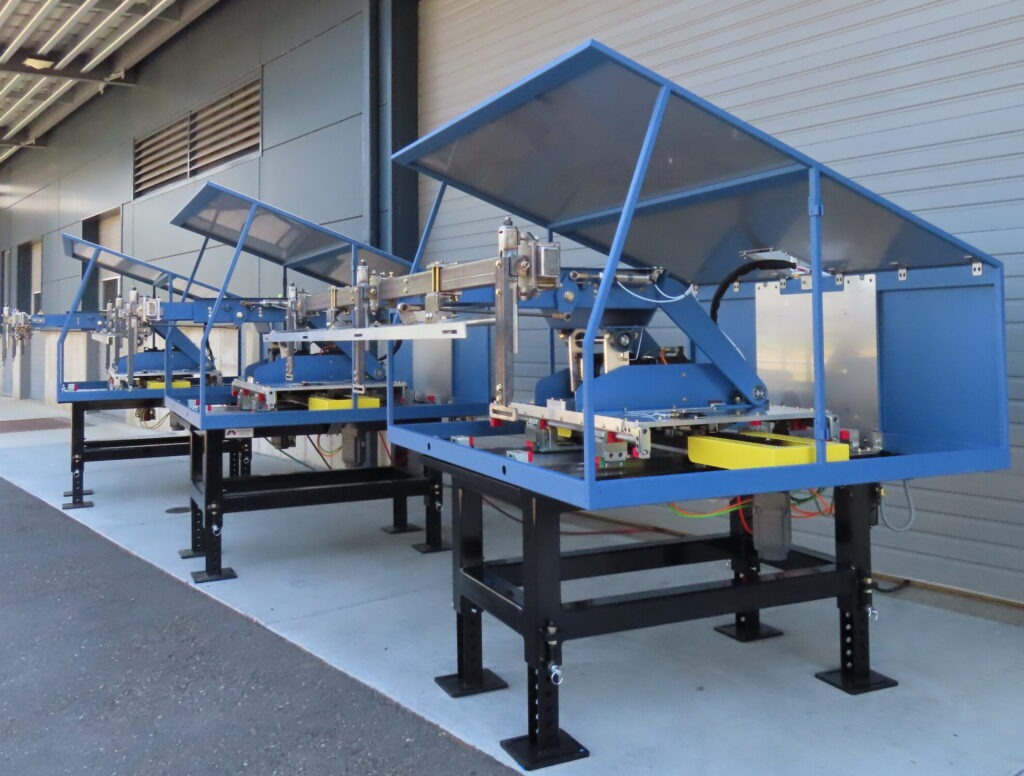
AMS redesigned from the maintenance technician up, not the spec sheet down. The Delta Stacker routes X and Y motion through stationary motors and a belt-driven delta configuration, drawing on parallel kinematic architecture originally developed for a precision motion application. Moving cable runs eliminated at the axes, removing the most common failure point. Four units were deployed at a container glass facility in Madera, California, and ran for two years before the next order was placed.

Result
The machine repair manager at Madera, unprompted, called it the best stacker he had worked with in 40 years in the glass industry. The Delta Stacker delivered excellent uptime, world-class lehr yield, and a maintenance profile any plant tech can manage. Three additional units are now in production for a second facility in Henderson, North Carolina.
How Applied Motion Systems rethought its own best-selling Servo Stacker to build one that works better for the people who operate and maintain them day in and day out, and proved it over two years in a high-volume container glass facility
The Problem: The Best Machine on the Market Had a Growing Maintenance Challenge
For more than 20 years, AMS built what many in the industry recognized as its most capable Servo Lehr Loader. The design used linear motors, borrowed from an AMS semiconductor processing application and scaled up for the glass industry, to achieve positioning smoothness and throughput that traditional, cam-driven stackers couldn’t match. Many units commissioned in the early 2000s are still in production today. The yield improvement into the Lehr was measurable.
The problem wasn’t performance; it was long-term maintainability, and it was getting harder to ignore.
Glass container plants run continuously with hot conditions and no shortage of stray glass dust getting into the works, and maintenance teams have gotten smaller and less specialized over the decades. A linear motor stacker requires trained technicians for maintenance activities. The encoder gap is critical, and motor replacements often involve shimming and careful realignment. Cables connecting the two moving axes flex with every cycle, which can wear them out over time. Those cables had become one of the most common maintenance failures in the design, requiring replacement every 3 – 5 years.
While the machine remained the best option going, the plants that ran it had changed, and years of maintenance and repair records highlighted an opportunity.
The Solution: A Platform Redesign That Started with Input from the Maintenance Tech, Not the Spec Sheet
The redesign work began during the pandemic, when reduced project volume created space for the kind of deliberate engineering required for a platform-level update.
The goal wasn’t to alter the linear-axis-based stacker features that had proven to be so beneficial; it was to build a parallel kinematic option, one with a lower acquisition cost, standard components any plant could stock, and a maintenance profile that didn’t require specialized knowledge to manage, maintaining the performance enhancements but approaching them a different way. With the new design, if a motor fails, the tech should be able to swap it the same way they’d replace any servo on the floor: no shimming, no encoder gap, and no special tooling they may not already have.
The mechanical solution came from an unexpected direction. AMS had previously designed a high performance Parallel Kinematic stage for a Microsoft application, an XY motion system that achieved precise positioning using stationary motors and a belt-driven delta configuration, entirely eliminating the moving cables. The same principle applied directly to the stacker problem. By routing the X and Y motion through a parallel kinematic mechanism driven by stationary motors, there was no need for the cables to flex thus eliminating a failure point that had from time-to-time caused maintenance headaches for technicians.
The design went through several build iterations before AMS was confident it matched the positioning performance of the linear motor platform. Then they deployed four units at a container glass facility in Madera, California, and let them run.
The Outcome: Two Years of Production, Additional Units on Order
The Madera installation has been running for two years. At a cross-functional review with plant operations, corporate engineering, and the AMS team, the machine repair manager offered a summary that wasn’t prompted:
“This is by far the best stacker I’ve ever worked with… and I’ve been in the glass industry for 40 years.”
He had run the older cam-driven stackers, and he had run AMS’s own linear motor units. The Delta Stacker outperformed them all, not on a specification sheet, but on the measure that matters most to the person responsible for keeping the line running when something breaks at 2 am. Excellent uptime, world-class yield through the Lehr, and easy to maintain.
Three additional Delta Stackers are now in production for deployment at a second facility in Henderson, North Carolina.
What Made It Different: Questioning Your Own Best Product
The previous linear motor stacker was genuinely excellent. This made it harder, not easier to replace, as there was no obvious failure driving the redesign, just a clear-eyed read on where the industry was heading and what the people running these machines needed from them to help the production facility flourish.
AMS didn’t start with a component substitution. They started with conversations with the maintenance techs: what breaks, why it breaks, and what a repair looks like for someone who isn’t a linear motion specialist. That framing led to a fundamentally different mechanical architecture, one that performs at the same level but is built around the reality of how glass plants operate today, not how they operated in 2003.
The Delta Stacker supports stagger stacking, mold-in-row stacking, and production flexibility features that glass operators value, just like the linear motor stackers.
The broader lesson: the best version of a product isn’t always the most sophisticated one, it’s the one that people who depend on it can trust and wonder how they ever lived without.
Technologies
- Parallel kinematic servo drive architecture
- Stationary motor / belt-driven XY motion
- Standard servo components for simplified field maintenance
- Multi-mode stacking configuration (stagger, mold-in-row)
About Applied Motion Systems
AMS is a systems integrator and machine builder. Our work spans motion control and industrial automation across glass containers, paper converting, forest products, aerospace tooling, renewable energy, and applications most companies haven’t tried before.
We start by learning the process: the machine, the material, the environment, and the constraints that govern how the system needs to work. We design for the environment the system will operate in, and we think about what it looks like years after commissioning, because that’s when building it right becomes obvious.
Key Takeaways
- AMS redesigned around the maintenance tech, not the spec sheet. The previous linear motor stacker was excellent on paper and lasted decades. The problem was what it asked of the people keeping it running at 2am in a hot, glass-dust-heavy environment when a motor cable had failed.
- Eliminating moving cables removed the most common failure point. The parallel kinematic architecture drives X and Y motion through stationary motors and a belt-driven delta bearing configuration. The cables that previously flexed with every cycle no longer move at all.
- Motor replacement now requires no shimming, no encoder gap, and no special tooling. A technician who can swap a standard servo on the plant floor can service this machine, without waiting on a specialist.
- This design matched the positioning performance of the linear motor platform before deployment. AMS ran multiple build iterations to confirm parity. Then let four units prove it over two years before the next order was placed.
- A 40-year industry veteran called it the best stacker he had ever worked with. He had run cam-driven stackers and AMS’s own linear motor units. The Delta Stacker outperformed them on the measure that matters most: keeping the line running.
Start the Conversation
All of our collaborations begin with an open dialogue.
More Case Studies
Industry
Technology