
Robotic Coating System for Hazardous-Location Applications

Problem
A major aerospace manufacturer needed a robotic coating system that many internal teams could use to apply different specialty coatings. Coating thickness was critical and determined whether each part could be approved for testing or production. The system also had to operate in a Class 1, Division 1 hazardous area, where no commercially available flex-rated cable carried the required rating.

Solution
AMS designed a gantry-style automated painting system that dynamically adjusts spray gun vector velocity to measured paint flow. A Coriolis mass flow sensor, a high-speed voice coil flow control system, and a Siemens Sinumerik CNC controller worked together to keep coating thickness precisely uniform. AMS engaged the Authority Having Jurisdiction (AHJ) where the system would be installed during design and selected every component to pass inspection.

Result
The system delivered uniform coating thickness across complex part geometries, measurably less paint waste, lower VOC emissions, and better first-pass yield than the system it replaced. Operators with different coating needs could program spray paths without specialized robot programming skills. The manufacturer has now relied on it in production for more than 15 years, with nearly zero downtime.
How Applied Motion Systems engineered a robotic painting system that matches spray speed to paint flow, giving an aerospace manufacturer more than 15 years of production in a Class 1, Division 1 paint booth
The Problem: Specialty Coatings in a Hazardous Booth, for Many Different Users
The coatings this system would apply had critical jobs to do. It would handle both testing and production work. One example was EMP-resistant coatings on avionics circuit boards, which help electronics survive the electromagnetic pulse from a nuclear blast. Another was radar-absorbing coatings on aircraft components and flight surfaces. On coatings like these, thickness determines whether the coatings work as intended.
The system also had to serve many different internal customers, each with different coating requirements. That meant it had to be easy to use and easy to set up for whoever stepped up to it next.
Then there was the environment. Paint vapors made the booth a Class 1, Division 1 hazardous location. Every motor, sensor, cable, and connection inside it had to meet that standard, and a gantry robot needs flexible cables that can cycle continuously. No commercially available cable was rated for both.
The Solution: A Robotic Painting System That Matches Gun Speed to Paint Flow
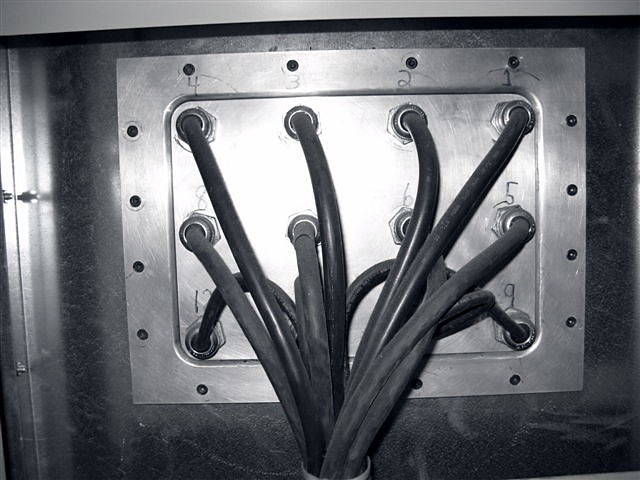
Hazardous-location requirements shaped much of the design. AMS built the system around explosion-proof motors and intrinsically safe sensors and wiring. AMS also chose and installed drivetrain components, flex-rated cables, and cable pass-throughs to suit automated machinery running in a paint environment.
To solve the cable problem, AMS involved the Authority Having Jurisdiction (AHJ) early, while the design was still underway. Working through cable selection and every other design element with the inspector ahead of time meant AMS built the system to pass inspection the first time. After extensive back-and-forth, the AHJ approved the cables.
The coating itself came down to two variables: how much paint leaves the gun and how fast the gun is moving. AMS controlled both together, so each one adjusted to the other. A Coriolis mass flow sensor tracked the actual mass of paint moving through the line in real time. The Siemens Sinumerik CNC controller then used its feedrate override to adjust the spray gun’s speed along its path to match that measured flow, so if flow drifted, gun speed adjusted with it. Meanwhile, a direct-drive voice coil fluid control system handled the flow itself. Its electronically controlled linear actuator updated position 200 times per second, keeping coats even and predictable on complex part geometries.
Ease of use was solved with a painting twist on a machining tool feature. AMS used the Sinumerik ShopMill conversational programming interface and created virtual “tools” shaped like the fan of paint coming out of the spray gun. Operators then “machine” the part geometry with those tools, much as a CNC programmer cuts a part from stock. Users with different coating needs could work out the best spray path quickly, without specialized robot programming skills.
The Outcome: More Than 15 Years of Production with Nearly Zero Downtime
Compared with the system it replaced, the AMS robotic coating system delivered uniform coating thickness across complex part geometries, measurably less paint waste from precise closed-loop flow control, lower VOC emissions as a direct result of less wasted material, and better first-pass yield, with fewer parts needing rework.
For more than 15 years, the manufacturer’s teams have kept the system in production with nearly zero downtime. That record reflects careful design and sound technology choices from the start.
What Made It Different: Bringing the Inspector into the Design
In a hazardous-location project, the component that fails inspection can stall everything. AMS found out what the local authority would accept while the design was still on paper. Engaging the AHJ during design turned a cable that didn’t exist off the shelf into an approved solution.
The same thinking applied to coating quality. AMS tied flow and speed together so the system corrected itself, and gave operators a programming method they already understood.
The broader lesson: in a paint booth, the hardest problems are often the ones outside the robot, and they’re easiest to solve before the first part is ordered.
Technologies
- Siemens Sinumerik CNC with feedrate override control
- Coriolis mass flow measurement
- Direct-drive voice coil fluid control (200 Hz position updates)
- Sinumerik ShopMill conversational programming with spray-fan tool geometry
- Explosion-proof motors and intrinsically safe sensors and wiring for Class 1, Division 1 locations
About Applied Motion Systems
AMS is a systems integrator and machine builder. Our work spans motion control and industrial automation across glass containers, paper converting, forest products, aerospace tooling, renewable energy, and applications most companies haven’t tried before.
We start by learning the process: the machine, the material, the environment, and the constraints that govern how the system needs to work. We design for the environment the system will operate in, and we think about what it looks like years after commissioning, because that’s when building it right becomes obvious.
Key Takeaways
- AMS brought the inspector in at the design stage. In a Class 1, Division 1 paint booth, one component the local authority won’t approve can stall an entire project. Engaging the Authority Having Jurisdiction while the design was underway meant every component was selected to pass inspection before anything was built.
- The cable the job needed didn’t exist off the shelf, and AMS worked with the AHJ until it was approved. A gantry robot needs flex-rated cables that cycle continuously, and the booth required cables rated for Class 1, Division 1 use. No commercially available cable carried both. After extensive back-and-forth with the AHJ, the selected cables were approved for use inside the booth.
- Paint flow and gun speed were controlled as one system. A Coriolis mass flow sensor measured paint flow in real time, and the Siemens Sinumerik CNC used feedrate override to adjust gun speed to match it. A voice coil flow control system updating at 200Hz worked to keep flow consistent and coating thickness uniform even with variability in fluid viscosity.
- Operators program spray paths the way machinists program parts. AMS built virtual tools in Sinumerik ShopMill shaped like the spray gun’s paint fan. Users with very different coating requirements can work out the best spray path quickly, without specialized robot programming skills.
- The manufacturer has operated the system for more than 15 years with nearly zero downtime. Compared with the system it replaced, the manufacturer saw less paint waste, lower VOC emissions, and better first-pass yield. The system’s long production record reflects careful component selection and sound design from the start.