
Glass Container Automation
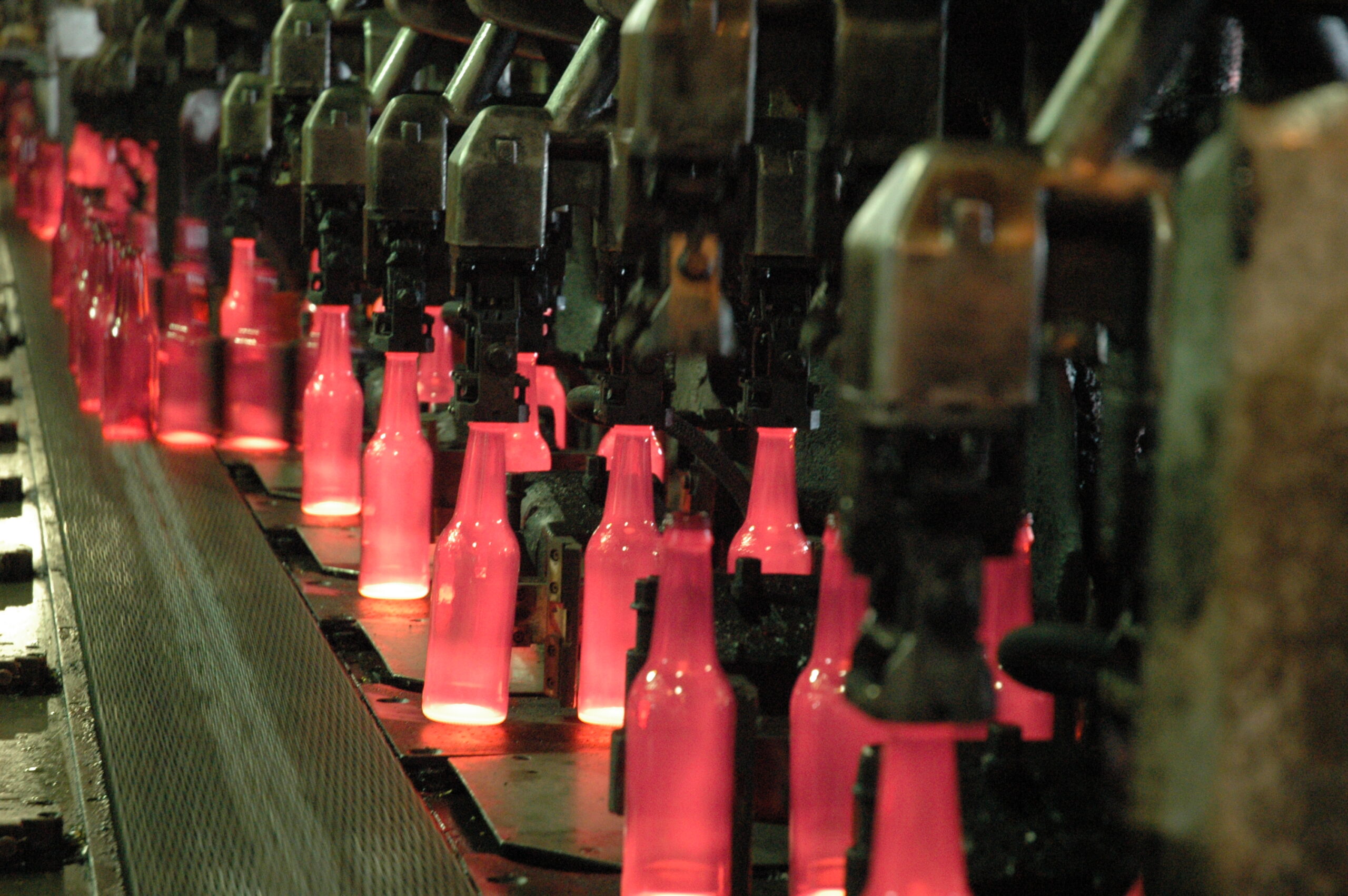
Glass container production lines are built around the IS machine, but the IS machine doesn’t run alone. The feeder, the shear, the gob distributor, and downstream equipment, including conveyors, transfer wheel and stacker all require precise, coordinated control. And each one must stay synchronized with the IS machine’s timing system through every setup parameter modification, production rate change, and job change.
That coordination is where glass container forming automation is won or lost. Gob weight inconsistency and gob distributor, shear or feeder timing that is slightly out of sync can cause immediate loading issues, but other issues don’t always announce themselves that clearly. They show up later, in defect rates and yield losses, after the forming section has already been running incorrectly.
AMS integrates and modernizes the controls and drive systems around IS machines on glass container production lines. We work on Emhart, Heye, and Bottero equipment, across Rockwell, Siemens, Omron, and Control Techniques platforms, and we’ve done it for over 30 years, long enough to know where the problems actually live. Glass container drive system retrofits are the most common entry point, but the work rarely stops there.
What We Work On
Servo feeder and shear drive systems
Gob weight and shape are set before the glass ever enters a mold section. We design and retrofit servo feeder and shear drive controls, where timing consistency is a direct input to the quality of glass container forming automation. A feeder or shear that is not holding precise timing tolerance doesn’t just affect one section; it affects every section it feeds.
Gob distributor control
Distributing gobs across multiple IS machine sections requires tight integration with the machine’s timing system. We’ve built and retrofitted gob distributor controls that maintain coordination through full production runs and provide automatic re-synchronization after job changeovers and uphold safety interlocks for section-down events.
Pushout automation
The handling equipment downstream of the IS machine has its own timing and drive coordination requirements. We’ve put servo controls on pushouts to ensure formed ware moves smoothly without damage or down ware.
IS machine timing integration
As a glass container IS machine integrator, we don’t design around the IS machine. We integrate with it. That means understanding the timing architecture and building controls that stay synchronized with it under real production conditions, not just at commissioning.
Glass container drive system retrofits
A significant portion of the glass container industry is running on aging control platforms. We retrofit and modernize drive systems and PLCs on Emhart and other OEM equipment without requiring full machine replacement or taking the line down longer than necessary.
The Platforms We Work On
Emhart Bucher is the most common IS machine OEM we encounter, particularly for glass container drive system retrofit work and forming mechanism upgrades. We also have hands-on experience with Heye and Bottero equipment.
On the controls and drives side, we work across Rockwell Automation/Allen-Bradley, Siemens, Omron, and Control Techniques, including mixed-platform environments common in older glass container production lines. If your line is running a legacy system that’s no longer supported, or you’re looking to migrate to a current platform, we can assess what’s there and build a path forward that minimizes line disruption.
How We Approach a Glass Container Project
We start with the present mechanical machine before we specify anything. What is the current timing system? What does the maintenance team know how to troubleshoot? Where have the problems been, and what workarounds have accumulated around them?
In glass container forming automation, those questions matter more than they do in most industries. The line runs continuously, downtime is not tolerated, and maintaining a safe environment is critical — hot glass can accumulate in a hurry, with fire risk and potential damage to mechanisms — there is no room to learn the process on the customer’s time.
What we’ve seen most consistently after a well-executed glass container drive system retrofit: more consistent timing, reduced defect rates and higher pack rate, and less down-time gives the operations team confidence in a line they may have been managing around for years.
Common Questions About Glass Container Automation
A few things customers and engineers typically ask before starting a conversation with us.
Let’s Talk About Your Line
Glass container lines are specific. So are we.
If you’re evaluating integrators for an IS machine retrofit, a servo feeder or shear drive upgrade, or a controls modernization on aging Bucher Emhart, Heye, or Bottero equipment, we’d like to understand what’s there.