
How to Safely Integrate Class IV Lasers into Industrial Automation Systems
Laser integration in industrial automation spans additive and subtractive processes alike, from the smallest sensors to the largest machine tools. Common uses include cleaning, marking, texturing, cutting, drilling, welding, and 3D printing. As a systems integrator and machine builder, AMS has invested significantly in deploying this versatile technology, simplifying its use for customers while meeting all applicable regulations and standards.
Integrating lasers into automation solutions can present a wide range of engineering challenges spanning multiple disciplines, including mechanical, electrical, and control system elements. At a basic level, engineers must consider things like laser physics, applications recipes, environmental cleanliness, and thermodynamic behavior. At a much higher level, they must navigate complex government regulations and standards because lasers pose serious safety hazards to humans.
Regulations and standards
At the Federal level, laser products and their implementation fall under the governance of the U.S. Food and Drug Administration Center for Devices and Radiological Health (FDA-CDRH). The Code of Federal Regulations (CFR), Title 21, Subchapter J ‘Radiological Health’ documents all definitions, procedures, and requirements. Additional state and local regulations may also apply. Major non-regulatory standards concerning lasers include International Electrotechnical Commission (IEC) standard 60825-1 and American National Standards Institute (ANSI) standard Z136.1. Many other organizations publish additional standards for specific contexts, including OSHA, NFPA, FAA, ACGIH, and ICNIRP*. Clearly, the integration of lasers into various types of machinery requires both specific administrative knowledge as well as engineering expertise in order to maintain proper compliance and functional safety.
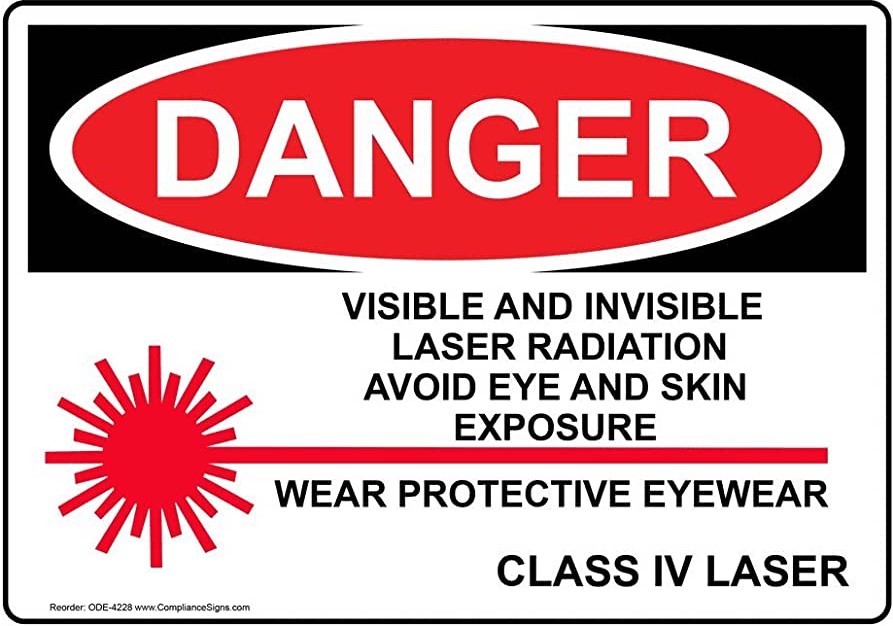

The classification system of laser products as defined in 21 CFR Part 1040 forms the basis for laser regulations. The FDA-CDRH classifies lasers into four classes based on the Accessible Emission Level (AEL) — the maximum laser light exposure a human may receive during product operation. Class I lasers are completely safe to operate without any protective equipment because of sufficiently low AEL or an enclosure that isolates harmful laser light (e.g. Lidar devices, CD player). Class II and above pose increasing hazards, with Class IV being the most dangerous, capable of causing severe eye and tissue damage in fractions of a second.
Reclassification
Most lasers used in industrial applications are Class IV, so how can they be implemented safely and effectively? Fortunately, this is familiar territory for AMS, having deployed several Class IV lasers in automated machinery. Users of Class IV laser products may reclassify their devices as Class I if they deploy the laser in accordance with established criteria such as ANSI Z136. Since a laser’s class depends on the AEL, a light-tight system that blocks all laser energy from escaping can qualify for recertification and reclassification under FDA-CDRH regulations. AMS has achieved successful reclassification in laser welding and marking applications, delivering enhanced safety, operability, and efficiency for our customers.
Designing with lasers
Deploying a Class IV laser within a Class I system means rethinking machine design from the ground up. All hazardous laser energy must stay enclosed within a light-tight container. This should be as easy as mounting the laser equipment to the inside of a metal box, right? Though this may sound simple, it can be quite challenging to implement this solution while juggling other requirements such as part presentation, air ventilation, and maintainability. Here are some creative ways engineers at AMS have overcome these obstacles.
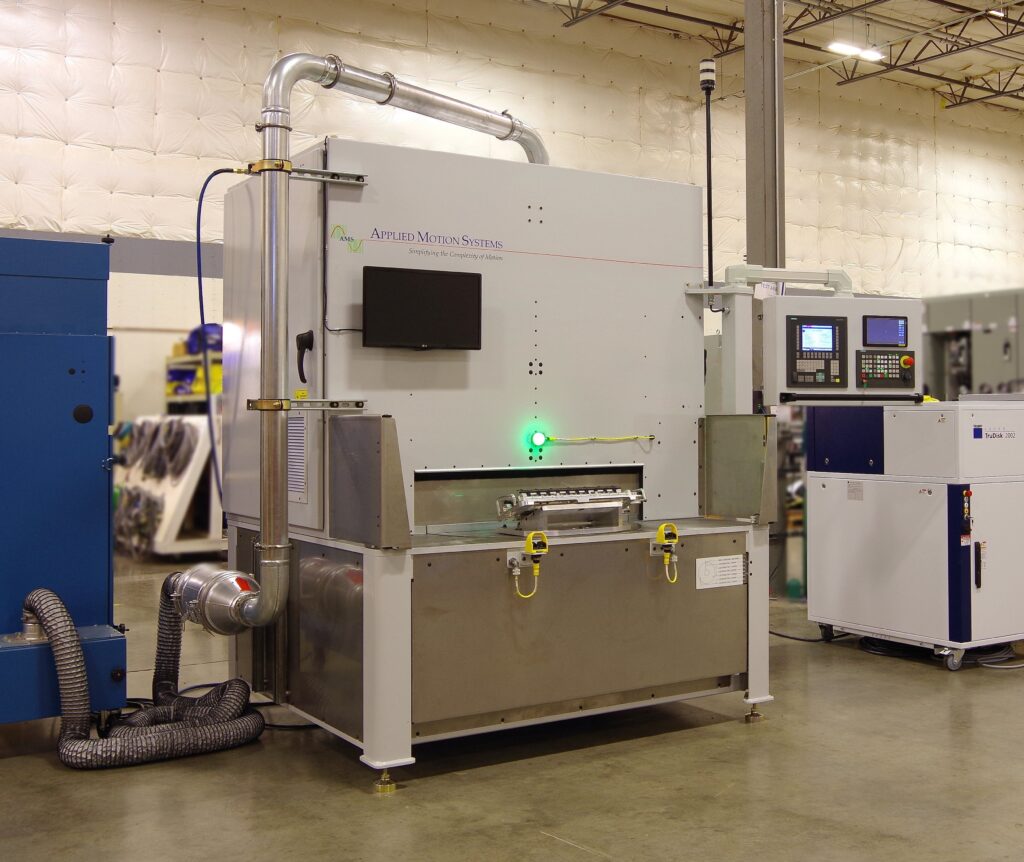
Part Presentation
In industrial laser applications such as welding and marking, parts must be introduced into the laser enclosure for processing and then removed post-processing, requiring both a door to access the enclosure and a mechanism to transfer the parts. The machine controls its own access points during operation, typically using pneumatic actuators. FDA-CDRH requires safety interlocks on all enclosure access points, inhibiting laser output whenever they are open.
To transfer parts in and out of the laser enclosure, AMS has deployed a variety of solutions. For example, a turntable design lets operators load and unload parts on one side — outside the enclosure — while the machine performs welding operations on the opposite side, inside the enclosure. The enclosure door operates in conjunction with the table, opening to rotate parts and closing to seal and safely operate the laser. Another excellent solution is to employ a robot to pick and place parts to be processed, reaching into the enclosure through the access door. While keeping operators safe from hazardous laser energy, these designs maximize repeatability and throughput for customers.
Air Ventilation
Industrial lasers operate reliably and at peak performance in clean environments free from contaminants; for example, condensation or other particles can damage laser optics almost instantaneously when illuminated by a high power laser. Additionally, some laser processes can produce harmful fumes (e.g. welding or marking of certain materials). Thus, ventilation is especially important but can be challenging to implement when the laser is enclosed in a light-tight container. With some creative thinking, AMS has overcome this challenge in a number of ways.
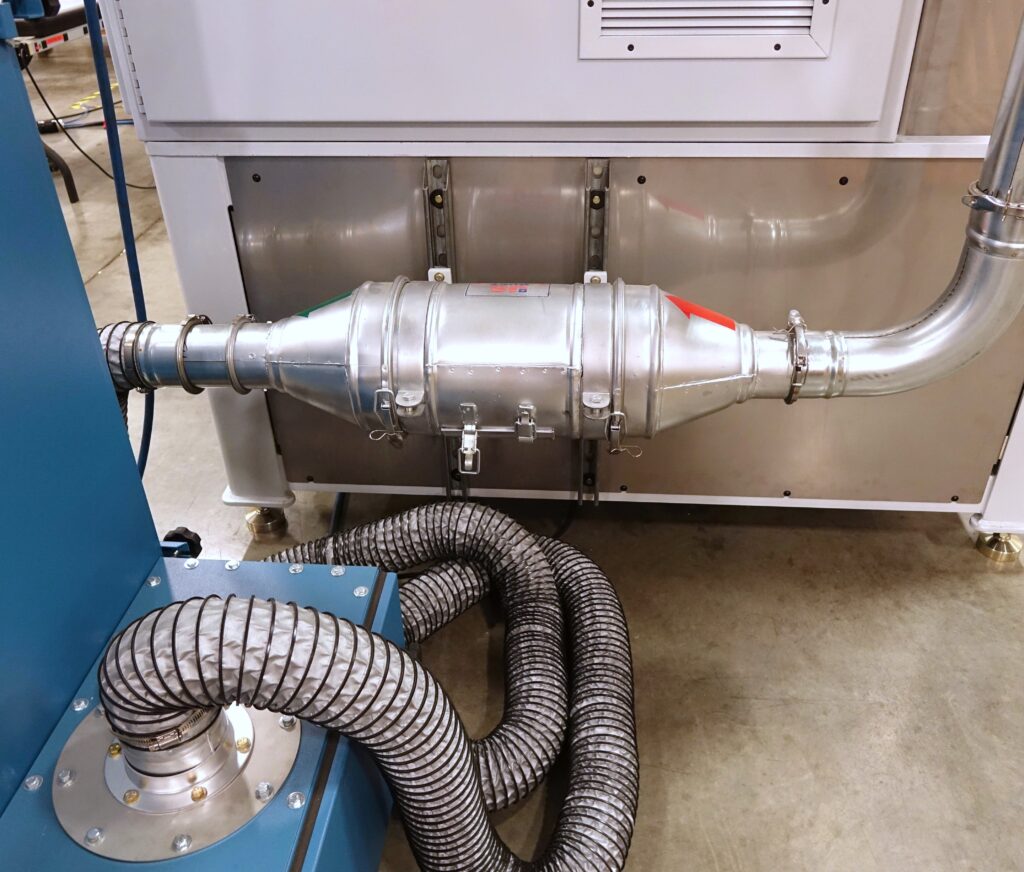
For smaller, simpler applications like laser marking, the enclosure may only need forced ventilation to remain clean and contaminant-free. AMS designs ventilation systems with filters on the outside of the enclosure, anticipating frequent replacements and the possibility of human error. Permanent interior light-blocking baffles maintain the light-tight requirement for Class I reclassification. Welding applications often generate harmful fumes that can escape when access doors open. AMS integrates fume extraction systems to protect operators. In these instances, AMS has integrated robust fume extraction systems to clean the air and keep operators safe.
Operability and Maintainability
Of course, laser containment and safety are the highest priority when considering reclassification. Our engineers also design closely around operability, ergonomics, and maintainability – qualities customers depend on beyond safety.
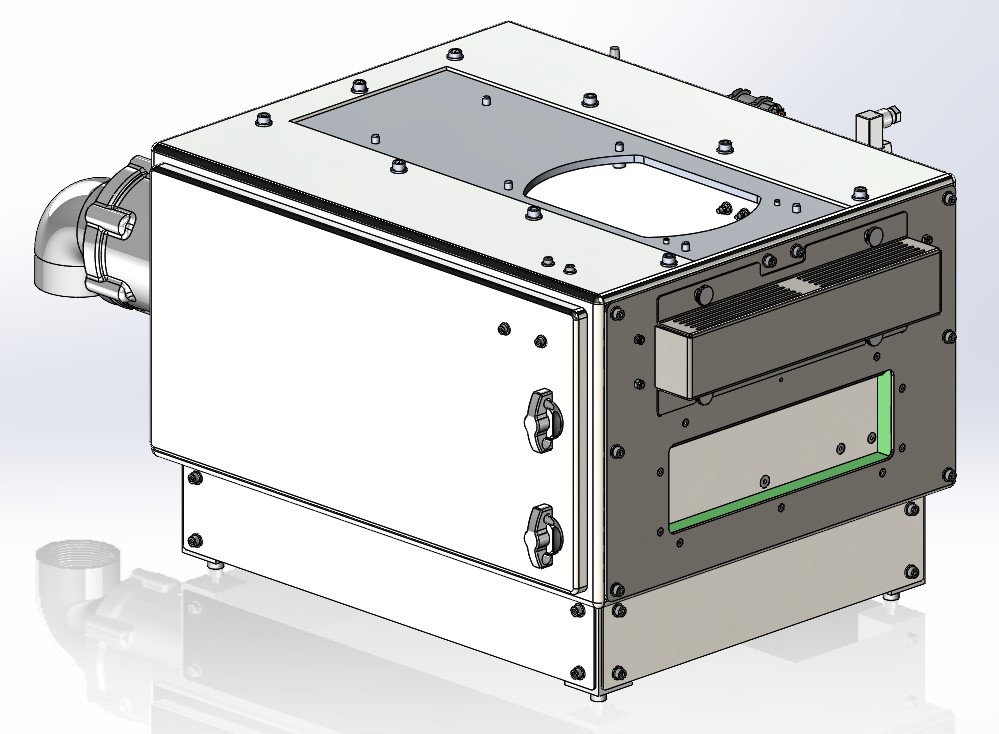
Without introducing needless complexity, AMS laser machines limit the components located within the enclosure to only those necessary for the process. Multiple manual access points let operators clear jams, replace components, and perform regular service without disrupting the enclosure design. Safety interlocks on manual doors inhibit laser output when open, matching the same protection applied to automatic access doors.
conclusion
It is not a trivial task to deploy a Class IV laser – powerful enough to cut, weld, or mark materials – in a safe, Class I system while maintaining required levels of performance. Accomplishing this requires in-depth knowledge of applicable standards and regulations and the ability to solve unique design challenges. Whether it’s part presentation, clean air supply, or accessible serviceability, AMS has the expertise to lead customers through every design and compliance challenge laser integration demands.
*Occupational Safety and Health Administration (OSHA), National Fire Protection Association (NFPA), Federal Aviation Administration (FAA), American Conference of Governmental Industrial Hygienists (ACGIH), and the International Commission on Non-ionizing Radiation Protection (ICNIRP)
Key Takeaways
- Most industrial lasers are Class IV and are powerful enough to cause severe injury in fractions of a second. Safe deployment requires reclassifying them as Class I through proper enclosure design and regulatory compliance.
- FDA-CDRH governs laser products in the US under 21 CFR Part 1040. Additional standards from IEC, ANSI, and OSHA also apply depending on the application.
- Reclassification to Class I is achievable by enclosing the laser in a protective housing with monitored safety interlocks on all access points.
- The hardest design challenges typically revolve around part presentation, air ventilation / toxic fume capture, and ease of maintainability.
- AMS has successfully deployed reclassified Class IV lasers in numerous welding and marking applications. Our team has experience with laser enclosure design, shutter safety interlocks, fume extraction, and all associated system controls under one roof.