
Glass Automation Integration
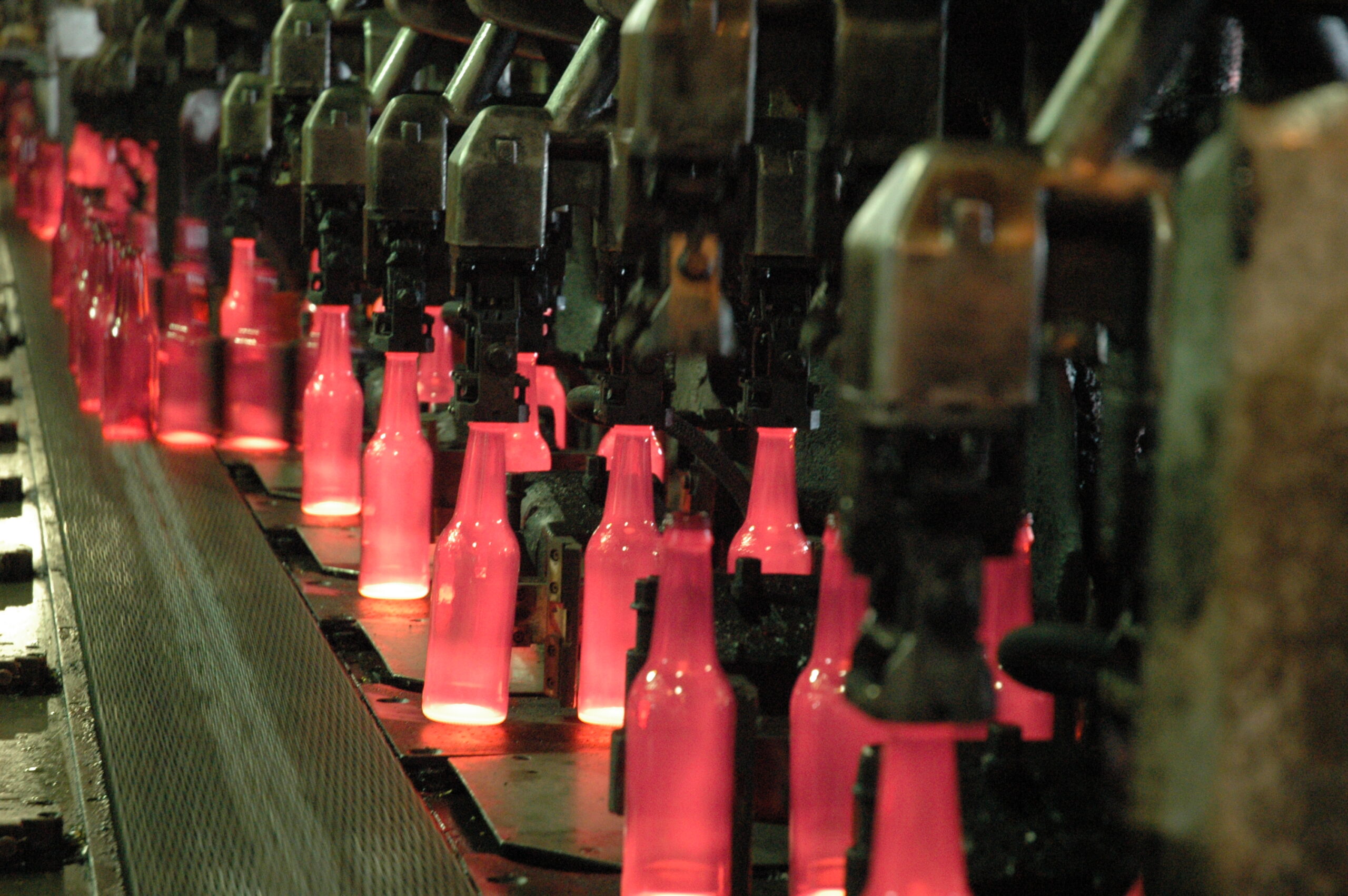
A glass container manufacturer was running mold cooling the way most plants do: manual damper adjustments, constant-speed fans, and operators making calls based on experience. The problem was that “more or less” showed up in the yield numbers. On an IS machine forming line, cooling consistency is a direct input to container quality. Too much variation in airflow, and the yield numbers tell you about it later. There was no plant-level visibility into how the system was performing, and no early warning before quality slipped.
AMS replaced manual adjustment with a closed-loop system that varies fan speed and inlet guide vane position continuously, using real-time feedback from duct temperature, pressure, ambient conditions, and IS machine status. When sections go down for mold swaps, the system compensates. When the machine transitions to a new job, it moves to standby and resumes automatically. Container quality and yield improved. Fan maintenance became predictable instead of reactive. And the facility gained its first real-time view of plant operations through a SCADA platform that has since expanded across multiple sites.
Glass Automation Is a Distinct Discipline
Glass container lines run 24 hours a day, seven days a week. Forming beer bottles, wine bottles, food jars, sauce containers, perfume vessels. The machine doesn’t stop, and neither does the pressure to keep it running cleanly. That environment demands more than general automation experience. It demands someone who understands the process.
IS machine lines operate at high speed with tight mechanical tolerances. The forming section, the feeder, the shear, and the gob distributor all have to work in coordination with each other and with the IS machine’s own timing system. A drift in timing doesn’t just slow things down. It shows up in defects.
The safety environment adds another layer. Hot glass flows continuously through the forming process. Fire risk is real. Glass that hardens mid-process can jam mechanisms. And because these lines are highly interconnected, a problem in one area doesn’t stay contained. It can cascade across the machine, bringing down production in multiple sections at once. That’s the environment every controls decision gets made in.
Glass Forming Operator Controls
An IS machine forming line runs continuously, but it’s operated by people. The operator managing the forming section needs to know at a glance whether timing is holding, whether a section is running clean, and what the system is telling them when something is off. Glass forming operator controls that aren’t built around that person create risk: slower response times, misread faults, and workarounds that accumulate over shifts.
AMS designs operator interfaces for glass-forming lines with the operator in mind. That means clear status visibility across sections, alarm structures that point toward the real problem rather than just annunciating a fault code, and controls that the maintenance team can navigate without calling us. On a line that runs three shifts, the controls have to work for every operator on every shift, not just the one who was there at commissioning.
What AMS Works On
AMS doesn’t rebuild IS machines. What we do is everything that works with them: the controls, the drives, the operator interfaces, and the peripheral systems that feed into and out of the forming section.
On the forming line, AMS works on feeder controls, shear drive systems, and gob distributor coordination. We work on pushouts and sweepouts as well, the mechanisms that move finished containers off the machine and into the downstream process. All of it has to be tightly integrated with the IS machine’s timing system. That integration is where the real complexity lives.
Most of the projects we take on in glass are retrofits. The most common IS machine platforms we work on are Emhart Bucher, Heye, and Bottero. The work ranges from single-component drive replacements to broader controls modernization involving PLCs, panels, and operator interfaces. Whatever the scope, the goal is the same: more consistent timing across the forming section, which is the most direct path to defect reduction. For a closer look at glass container forming automation specifically, including IS machine integration, drive system retrofits, and platform expertise, see our glass container automation page.
Key Takeaways
- Glass automation runs 24/7, and the controls have to match. Forming lines don’t stop for shift changes, job transitions, or section swaps. The systems we build are designed to stay synchronized through all of it.
- Operator controls are part of the engineering, not an afterthought. The person running the forming section every shift needs to read the system clearly and respond quickly. We design for that person from the start.
- The safety environment in glass is specific. Hot glass, fire risk, hardening glass, and highly interconnected machinery mean there is no room to learn the process on the customer’s time.
- Most of our glass work is retrofits. We modernize drive systems and controls on Emhart Bucher, Heye, and Bottero equipment without requiring full machine replacement or extended line downtime.
- Consistent timing is the outcome that matters most. After a well-executed retrofit or controls modernization, defect rates decline, and the operations team gains confidence in a line they may have been managing for years.
Let’s Talk About Your Line
Glass container lines are specific. So are we.
If you’re dealing with timing inconsistencies that affect defect rates, a legacy drive system on an Emhart Bucher, Heye, or Bottero line that’s overdue for replacement, or operator controls that your floor team has learned to work around rather than rely on, we’d like to understand your operation.