
Coordinated Multi-Vehicle Motion for Large-Scale Airframe Assembly Tooling

Problem
A major U.S. aerospace manufacturer’s research division needed a new approach to airframe assembly. Four Mecanum-wheel vehicles had to move a rigid structure as a single coordinated platform. A previous integrator had worked the problem for over two years without solving it. If the vehicles didn’t move in a shared coordinate frame, the structure would experience damaging, indeterminate loads at every attachment point.
Solution
AMS implemented the kinematic model on the Siemens platform, validated single-vehicle motion first, then built outward to coordinated multi-vehicle operation. A laser tracker verified results at each stage. The engagement ran in distinct phases over roughly three years, gated by the customer’s funding cycles. Each phase produced something demonstrable. Each demonstration secured the next.

Result
The system proved the model worked. Multi-vehicle coordinated motion — four platforms, one rigid structure, one shared coordinate frame — was validated at the confidence level the customer needed. The R&D program concluded successfully. What a previous integrator had not solved in over two years, AMS solved in less than 90 days of active development.
How Applied Motion Systems solved a multi-vehicle coordination problem for a major U.S. aerospace manufacturer’s research division, delivering a proof-of-concept in about 3 months after a previous integrator had spent more than two years on the same problem
The Problem: Four Vehicles, One Wing, No Margin for Disagreement
A major U.S. aerospace manufacturer’s research division needed a better way to handle large airframe structures during assembly. The existing approach relied on fixed, dedicated tooling with a separate jig for each part configuration. What they wanted was a flexible fixture system: a set of mobile vehicles that could reconfigure to support different structures, move them across the floor, and hold them in precise position during assembly operations.
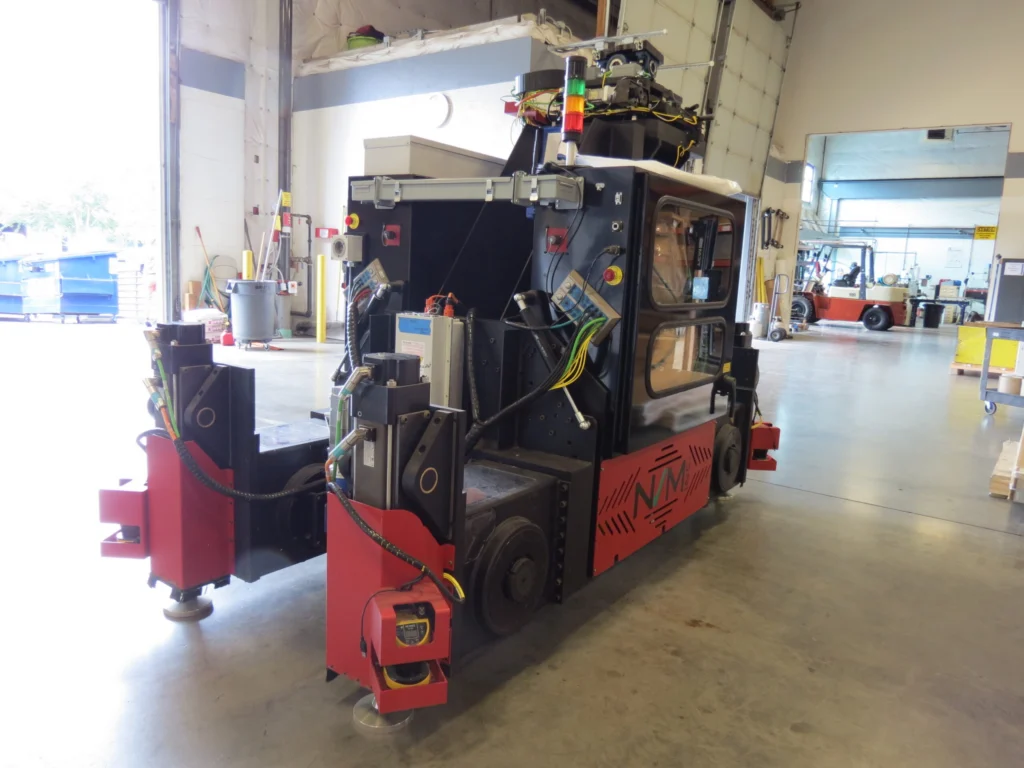
The vehicles ran on Mecanum wheel sets, a drivetrain that allows movement along any vector, forward, backward, sideways, and diagonal, without turning the vehicle. One vehicle doing that is a tractable problem. What the customer needed was four vehicles working simultaneously while precisely positioning a rigid structure.
A wing, held at four points by four independent vehicles, is subject to indeterminant loading and damage if the vehicles don’t move together in perfect coordination. Each vehicle’s motion has the potential to generate forces at every attachment point. If vehicle motion is not coordinated within a shared coordinate frame, the structure will experience undue stress and potential damage. The vehicle-based fixture system needed to treat four separate vehicles as a single platform, not four platforms trying to coordinate.
A previous integrator had been working on this problem for over two years with little in the way of progress. The customer came to AMS.
The Solution: Find the Right Model First
AMS came into the project with limited experience on the Siemens platform upon which the system was based. This was acknowledged early. The approach was iterative: identify key kinematic requirements, learn the best way to implement with the Simotion platform, make demonstrable progress, and return with something to validate on-site.
The mathematical foundation came from an unlikely source: a white paper written by the parent of a high school robotics club. The paper presented kinematic models for single-vehicle motion within local and global coordinate systems. It also showed how to calculate the wheel rotation required to achieve any desired trajectory. From that foundation, AMS extended the model to multiple vehicles operating in a shared global coordinate frame. That second part was the key. Moving a rigid structure with multiple vehicles requires transforming each vehicle’s local motion commands into a common reference frame so that all attachment points move in unison.
From Single Vehicle to Coordinated Platform
AMS implemented the kinematic model on the Siemens platform, validated single-vehicle motion first, then built outward to coordinated multi-vehicle operation. A laser tracker provided the external reference needed to verify that the vehicles were moving the distances and angles they were commanded, checking position, travel distance, and rotation against a known ground truth.
The engagement ran in distinct phases over roughly three years, gated not only by technical progress but by the customer’s internal funding and planning cycles. Each phase produced something demonstrable. Each demonstration was sufficient to secure the next phase. Three AMS engineers contributed across the project’s life; the final wing-to-fuselage join, the validation of the full coordinated system, was executed in the project’s last phase.
The Results: A Two-Year Problem Solved in 90 Days
What the record shows: the core problem was solved in less than 90 days of active development. The previous integrator had not solved it in more than two years.
What Made it Different
The previous integrator had the same platform, the same problem statement, and more time. What changed wasn’t the technology.
AMS didn’t begin by writing motion code. They began by finding the right description of the problem, the kinematic model that would let multiple vehicles share a coordinate frame and move as one. Recognizing it, understanding it, and implementing it rigorously on the target platform was the work.
The willingness to disclose our status of being novices with the Simotion platform also mattered. The team didn’t have deep prior experience on this platform when the project started, and we said so. What they brought instead was the discipline to learn iteratively, spend time on the platform, work with the vendor, go on-site and test, repeat, and make enough progress at each stage that the customer had reason to continue.
Progress on hard problems often looks like this: not a single breakthrough, but a sequence of demonstrable steps, each one building the case for the next.
Technologies
- Mecanum wheel omni-directional drive coordination
- Forward and inverse kinematics for multi-vehicle rigid body motion
- Siemens Simotion + Sinamics automation and motion control platform
- Laser tracker integration for positional verification
- Global coordinate frame transformation for synchronized multi-vehicle operation
About Applied Motion Systems
AMS is a systems integrator and machine builder. Our work spans motion control and industrial automation across paper converting, web handling, forest products, aerospace tooling, renewable energy, and applications most companies haven’t tried before.
We start by learning the process: the machine, the material, the environment, and the constraints that govern how the system has to work. We design for the environment the system will operate in, and we think about what it looks like five years after commissioning, because that’s when building it right becomes obvious.
If you are working through a motion control or automation challenge in a demanding environment, we would welcome the opportunity to discuss it with you.
Key Takeaways
- The right model mattered more than the right hardware. The previous integrator had the same platform and more time. What changed was finding the kinematic framework that let multiple vehicles share a coordinate frame and implementing it rigorously.
- Four Mecanum-wheel vehicles had to move as one. A wing held at four points by independent vehicles creates indeterminate loading if the vehicles aren’t coordinated within a shared global frame. The math behind that coordination was the core problem to solve.
- AMS disclosed what they didn’t know, and it worked in their favor. The team entered the project without deep Simotion experience. They said so, worked iteratively with the vendor, validated on-site at each phase, and earned continued investment through demonstrable progress rather than confident claims.
- Each phase produced something the customer could see. The engagement ran across roughly three years, driven by the customer’s funding cycles more than technical progress. Every phase ended with a working demonstration that justified the next one.
- The proof-of-concept did what research is supposed to do. The system reached the confidence level needed to close out the program. A previous integrator had worked the same problem for over two years without solving it. AMS validated the approach in 90 days of active development.