Oscilla Power had developed something genuinely novel: the TRITON-C, a 100 kW-rated wave energy converter designed to bring renewable power to remote and isolated coastal communities. The device works by capturing relative motion between a surface floating vessel and a submerged reaction ring, extracting energy from ocean waves across all six degrees of freedom, something most wave energy systems can’t do.
Electrical Power System for Oscilla Power’s TRITON-C Wave Energy Converter
How Applied Motion Systems engineered a marine-grade power conversion and storage system to capture, condition, and deliver renewable energy from the open ocean
The Problem: Converting Chaotic Ocean Energy into Usable Power
Wave energy is abundant. The engineering problem is that it doesn’t behave like power from a grid.
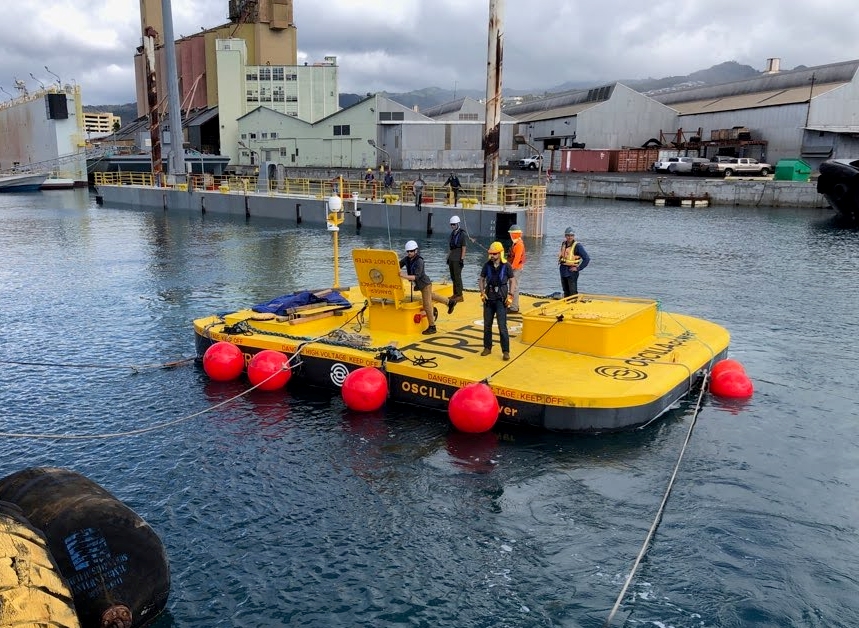
But converting that mechanical energy into electricity that can actually reach the grid is a different problem entirely. The ocean doesn’t deliver consistent power. Energetic sea states produce large peak currents and voltages. Between those peaks, output drops to near nothing. Conventional power electronics aren’t designed for that kind of variability, and the hardware that houses it all has to survive the same environment it’s harvesting energy from: saltwater, constant motion, storm conditions, and years of continuous offshore deployment.
The ask: design and build an electrical power system that could handle unpredictable generator output, smooth it into stable exportable power, store energy for grid reliability and black-start capability, and do all of this inside a vessel deployed offshore Hawaii.
The Solution: A Marine-Grade Power Conversion and Storage Architecture
AMS engineered the complete electrical power system for the TRITON-C, working within the constraints of the vessel’s physical space, the offshore environment, and the highly variable nature of wave energy generation.
The system runs on a 720 VDC bus. That voltage was deliberately chosen as it provides the system with enough headroom to handle peak generator output while maintaining a stable export level to shore. Three independent hydraulic drivetrains feed three generators. AMS designed a Siemens Sinamics-based generator inverter drive system to manage all three simultaneously, using a Sinamics CU320-2 drive controller to handle inverter commutation, current and torque limits, and generator velocity, adapting in real time to whatever conditions the ocean was delivering.
The energy storage architecture is layered. A supercapacitor bank, with 11 Farads of capacitance operating at the bus voltage, absorbs and releases energy quickly, smoothing the power spikes and gaps inherent to wave energy. For longer-duration storage and black-start capability, a fourth cabinet houses Lithium Iron Phosphate batteries operating at 310 VDC, connected to the system through a 30 kW DC-to-DC converter allowing bidirectional power flow between the 720VDC bus and the 310VDC bus. This combination means the system can ride through gaps in wave activity and restart from a de-energized state without relying on external power.
The control system draws on AMS’s prior experience with energy recovery applications. Algorithms developed for a previous project, a turbine-in-pipe system deployed in Portland’s municipal water infrastructure, were adapted here to handle the challenge of controlling voltage and current simultaneously across a wide power input range. This is not standard inverter territory. It required custom control logic built for this specific application.

Sinamics Motion to Grid Hardware package
All hardware is shock-mounted in reinforced, marine-rated enclosures. Everything aboard the vessel is designed to withstand high-energy sea states, not as a specification afterthought, but as a basic requirement for a system that may be deployed thousands of miles from the nearest service facility.
Power exports to shore at a steady-state 720 VDC, delivering up to 100 kW continuous to an onshore UL1741 rated grid connected inverter.
The Results: What the System Had to Prove
Stable power export in a fundamentally unstable environment. The combination of supercapacitor buffering and custom inverter control algorithms allows the TRITON-C to deliver consistent, conditioned power to shore even as generator output varies with wave conditions. The variability problem, one of the central engineering challenges of wave energy, is addressed in the onboard power electronics at sea, rather than worked around onshore.
A system designed for where it will actually operate. Marine deployments don’t allow for easy service calls. The Siemens-based architecture was selected in part because components are globally available and field-serviceable wherever these systems are eventually deployed. That’s a practical consideration, not a marketing point.
A platform built for scale. The TRITON-C is Oscilla Power’s community-scale system. The larger TRITON, targeting 1 MW output in utility-scale arrays, is designed around the same architecture. The electrical system AMS built for the 100 kW prototype is intended to carry forward into that next phase of development.
AMS’s involvement continued beyond the original TRITON-C deployment. When Oscilla Power began development of a 1:6 scale TRITON prototype for testing off the coast of Maine, AMS was again named one of the project’s core engineering partners.
About Applied Motion Systems
AMS is a systems integrator and machine builder. Our work spans motion control and industrial automation systems across paper converting, web handling equipment, aerospace tooling, renewable energy, and applications most companies haven’t tried before.
We design for the environment the system will actually operate in, not the one we’d prefer it to occupy. And we think about what the system looks like five years after commissioning, because that’s when the value of building it right becomes obvious.
If you are working through a motion control challenge in a difficult environment, we would welcome the conversation.
start the conversation
All of our collaborations begin with an open dialogue.
Get in touch with us using this simple form, and a member of our team will follow up with you soon.